30-second takeaway: No beach blanket is sand-free, and anything sold as sandproof is overselling. What a good one does is stop sand from lodging in the fabric, so it shakes off in one motion instead of coming home with you. The things that actually make the difference are a tight-weave top rather than a looped one, a waterproof underside, and enough weight at the corners that the blanket never lifts and lets sand underneath.
The honest answer: no, and be wary of anyone who says otherwise
Sand is a mineral powder that moves with wind, water and static. It will land on your blanket. It will land on you. Nothing woven from fabric and laid on a beach is going to prevent that, and a product described as sand-free or sandproof is making a claim it cannot keep.
So that's the wrong question. The useful one is narrower:
Does the sand sit on top of the fabric, or does it get into it?
That single difference is what separates a blanket you shake out in five seconds from one you're still finding sand in come October. And unlike "sand-free," it's a real, testable property of the material.
Why sand gets into most beach blankets
Three things are happening, and most blankets fail at more than one.
1. The weave has somewhere for sand to go
A cotton beach towel — including the Turkish-style ones sold as blankets — is built from loops of yarn. Those loops exist to hold water, which is exactly what you want in a towel, and they hold sand grains just as willingly. Shaking a looped fabric doesn't clear it, because the sand isn't resting on the surface; it's wedged between the loops.
A tightly woven flat fabric has nowhere for a grain to wedge. The sand sits on the surface. One shake and it's gone.
2. Damp sand wicks up from below
Beach sand a few inches down is damp. Lay a single-layer permeable fabric on it and moisture moves upward through the weave, carrying fine sand with it. You end up with a blanket that's gritty on the side you're sitting on, having never spilled anything on it.
A waterproof backing stops that transfer completely. It's the least glamorous feature on a beach blanket and one of the two that matter most.
3. The blanket lifts, and sand goes under and around
This is the one people miss. A lightweight blanket on a breezy afternoon doesn't need to blow away to be a problem. It only has to lift at a corner. Every lift pumps air underneath and drags sand in from the edges, and every flap deposits more on top.
Weight at the corners isn't really about keeping the blanket from flying off. It's about keeping the fabric flat against the ground so there's no gap for sand to get into.
What actually works, in order of how much difference it makes
- A flat, tight-weave top layer. Quick-dry microfiber or a similarly dense weave. If you can push a fingernail into a loop, sand can get in there too.
- A waterproof underside. Stops damp sand wicking through from below. Also means you can put the blanket on wet sand near the waterline.
- Corners that stay down. Pockets you fill with sand, or weighted corners. Both work. Loose stakes are a fourth thing to carry and lose.
- Shaking it correctly. Stand with your back to the wind, hold two corners, and snap it once, hard, so the sand leaves downwind. Folding a sandy blanket just relocates the sand into the fold.
- Dry hands and feet before you sit down. Wet skin is how most of the sand arrives on the fabric in the first place. A sand remover glove handles this in about ten seconds, and it's the step almost nobody does.
Cotton towel vs nylon parachute vs woven microfiber
| Cotton / Turkish towel | Nylon parachute blanket | Woven microfiber with waterproof backing | |
|---|---|---|---|
| Does sand shake off? | No — lodges in the loops | Yes | Yes |
| Damp sand from below? | Wicks straight through | Wicks through (single layer) | Blocked by the backing |
| Stays flat in a breeze? | Heavy enough, usually | No — very light, lifts easily | Yes, with filled corner pockets |
| Comfortable to lie on? | Yes | Thin and slippery | Yes |
| Dries quickly? | No | Yes | Yes |
Each category is good at something. The cotton towel is the nicest thing to lie on and the worst at sand. The nylon parachute blanket shakes clean and packs small, and it folds over on itself in the first real gust. Neither was designed for a beach; one was designed for a bathroom and the other for a backpack.
What we built, and what it doesn't do
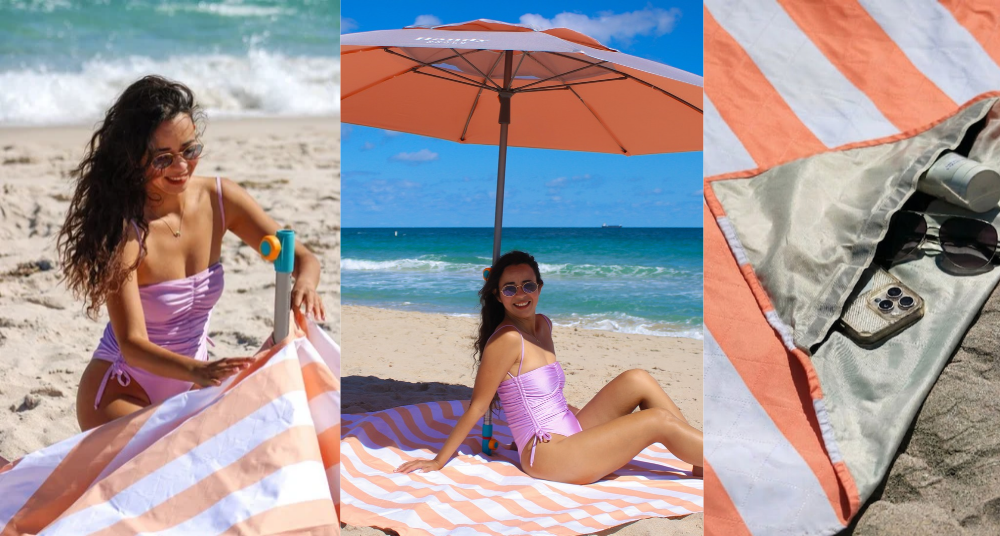
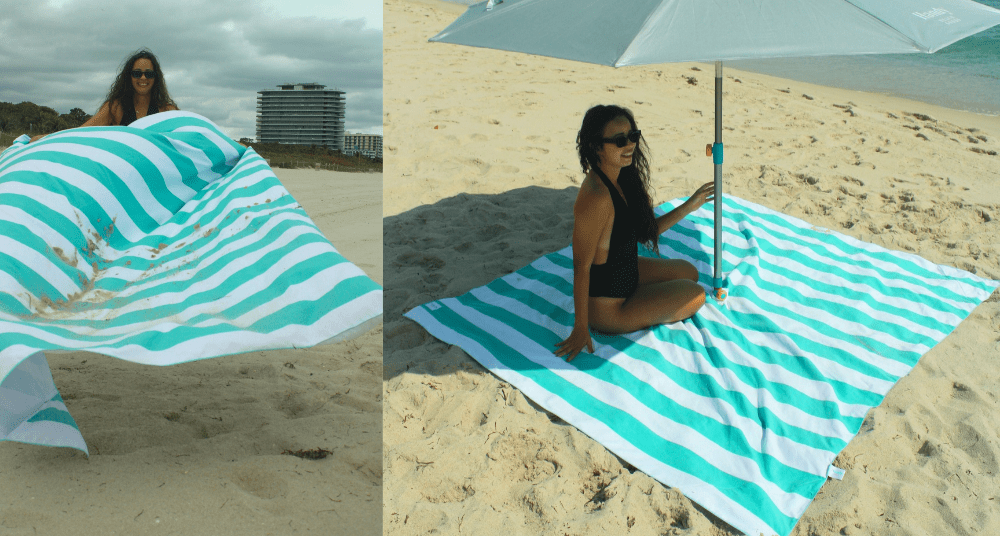
Our oversized beach blanket is 7ft × 7ft, $49.99. A quick-dry, sand-repellent microfiber top, a waterproof underside, and four corner pockets with Velcro openings on the underside that you fill with sand — or with your shoes, keys and phone if you'd rather. There's a reinforced port in the centre for an umbrella pole — bound rather than cut, so it lies flat, stays closed and is barely visible on the days you don't bring one. More on that in beach blanket with an umbrella hole. The fabric is made from recycled plastic bottles, around 40 per blanket.
CNN Underscored named it best beach blanket under $50, and Travel + Leisure picked it for best beach blanket design.
Now the honest part, because this is an article about overselling:
- It is sand-repellent, not sand-free. Sand lands on it. It shakes off in one motion rather than staying in the weave — that's the whole claim.
- Wet sand still clings. Any damp fabric holds damp sand. Let it dry for a minute and then shake.
- You still have to shake it. There is no blanket that cleans itself.
- The corner pockets need filling. Empty pockets are just pockets. Two handfuls of sand in each is the difference between flat and flapping.
Frequently asked questions
Are sandproof beach blankets real?
No. Sand will land on any blanket you put on a beach. "Sandproof" and "sand-free" describe something no fabric achieves. What's real is sand-repellent: a weave tight enough that sand sits on the surface and leaves when you shake it, instead of working into the fibres and staying.
What's the actual difference between sand-free and sand-repellent?
Sand-free is a promise about the sand. Sand-repellent is a description of the fabric. Only one of them is a property you can test — lay the blanket down, throw a handful of dry sand on it, shake once, and look.
Does a waterproof beach blanket get less sandy?
Yes, and more than people expect. A lot of the grit on a beach blanket arrives from underneath, wicking up with moisture from the damp sand a few inches down. A waterproof backing stops that entirely, which is why it matters as much as the top layer does.
How do you get sand off a beach blanket?
Let it dry for a minute if it's damp. Stand with your back to the wind, take two corners, and give it one hard snap so the sand goes downwind and away from you. Don't fold first — folding traps the sand in the crease and you carry it home.
Can I just use a beach towel instead?
You can, and it will be comfortable, and the sand will stay in it. Towel loops are built to hold things. If you don't mind that, a towel is fine. If the sand is the thing that bothers you, the loops are the reason.
Do blankets with corner pockets work better than stakes?
They work about as well and there's nothing extra to carry or lose. Stakes also don't hold reliably in dry, loose sand near the top of the beach — the same problem that makes screw-in umbrella anchors slip. Pockets filled with the sand that's already under your feet don't have that failure mode.
The honest verdict
Stop looking for a sand-free beach blanket, because it isn't a product category — it's a marketing phrase. Look for a flat tight weave, a waterproof underside, and corners that stay down. Those three things are the entire difference between a blanket you shake out at the car and one you're still vacuuming in November.
If you want the fuller comparison across every blanket category, it's in our best beach blanket breakdown. And if the sand on you is the real problem rather than the sand on the blanket, we wrote about that separately in sand-free beach hacks.
About the Author
Written by Agnes, co-founder of Handy Beach Goods and a Florida mom. We design our gear in Florida and test it on the beaches we actually use.