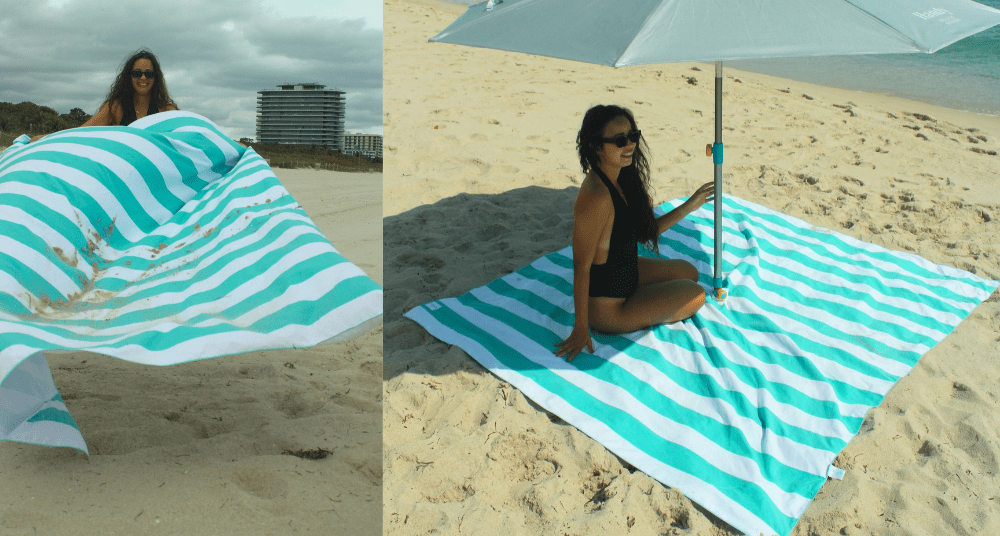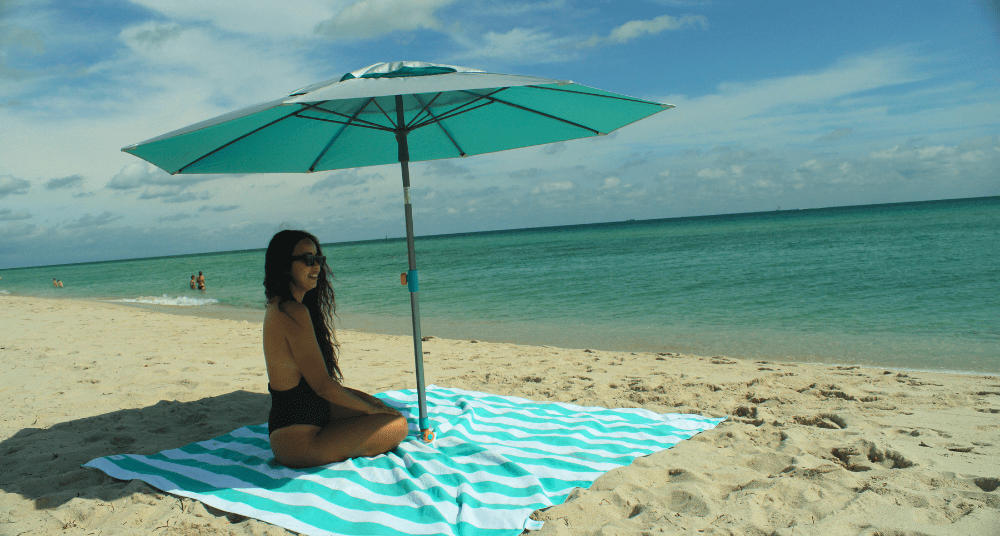

30-second answer: Yes. A 2017 study in JAMA Dermatology found that after three and a half hours at the beach, 78% of people using only an umbrella were sunburned — against 25% of those using only sunscreen. An umbrella blocks the sun coming straight down. It cannot block the UV reflecting up off sand and water, or scattering in from the open sky at the sides. Shade is the right first layer; it just isn't the only one.
The study, and why it surprised people
Researchers put two groups on a beach for three and a half hours. One group used only SPF 100 sunscreen. The other used only a standard beach umbrella, and no sunscreen at all.
- Umbrella only: 78% showed sunburn.
- Sunscreen only: 25% showed sunburn.
The finding is published in JAMA Dermatology.
It is easy to read that as "umbrellas don't work." That isn't the lesson. Neither group was burn-free, and the real conclusion the authors drew is that no single method was sufficient on its own. What the study exposes is a specific, physical gap in how shade works — and once you know what it is, it's straightforward to close.
Where the UV is coming from
Three separate paths, and a canopy only covers one of them.
1. Reflected UV, from below
Dry sand reflects roughly 15% of UV back upward. Water reflects as well, and more when the surface is broken and choppy. You are effectively sitting inside a shallow bowl of reflectors, and that light arrives at your chin, your nose, the undersides of your arms and the tops of your feet — from angles sunscreen handles and shade does not.
This is the main mechanism, and it is the one nobody expects.
2. Scattered UV, from the sides
UV doesn't travel only in straight lines from the sun. It scatters through the atmosphere, which is why you can burn on an overcast day. An umbrella is a disc above you with open air on all sides, so that diffuse light reaches you more or less unimpeded.
The practical consequence: the deeper you sit under the canopy, the better. Sitting at the edge of the shade circle, with half your body in the open, is much worse than sitting in the middle — even though both look like "being in the shade."
3. UV straight through the fabric
This is the one that varies enormously between products. A thin, loosely woven canopy passes a meaningful share of UV through the weave itself. A dense one stops nearly all of it. The figure that tells you which you have is UV transmission — the percentage that passes through the material.
Our 7ft canopy is 160gsm recycled polyester with a reflective silver layer on its top surface, independently lab measured at 0.008% transmission — 99.99% of UV blocked. Most listings in this category quote only a UPF band, and the consumer UPF scale is capped, so two very different fabrics can carry the same label. We went through that in detail in the truth about UPF vs SPF.
But note what that figure can and cannot do. 99.99% describes the light hitting the top of the canopy. It says nothing about the 15% coming off the sand. A better canopy closes path 3 completely and leaves paths 1 and 2 exactly as they were.
So what actually works: three layers
Layer 1 — Shade that stays where you put it
Shade is still the most valuable thing you can do, because it removes the largest single dose: the direct overhead sun during the hours it is strongest. Two things make it count.
- Fabric density. Ask for the UV transmission percentage, not the UPF rating.
- Stability. A canopy that shifts or comes down stops protecting anyone. Shade that moves is shade you stop trusting — which is its own kind of failure.
Layer 2 — Sunscreen, for the light shade can't reach
This is the layer that handles reflection and scatter, and the study above is the argument for it.
- Broad-spectrum SPF 30 or higher. Broad-spectrum means it covers UVA as well as UVB.
- Use enough. About one ounce — a shot glass — for a whole adult body. For the face, the two-finger rule works.
- Apply 15 minutes before you go out, then reapply every two hours, and after swimming or heavy sweating.
Most under-protection is a dosing problem rather than a product problem. People apply roughly a quarter to half of what the SPF number was tested at, which means an SPF 50 behaves closer to an SPF 15.
Layer 3 — Cover the gaps
A wide-brimmed hat, UV-blocking sunglasses, and a rash guard or UPF shirt for anyone in and out of the water. These close the spots that get missed every single time: ears, the back of the neck, the parting in your hair, and the tops of the feet.
The five places people burn under an umbrella
- Tops of the feet — pointed straight at the sand, which is the reflector.
- Shins and calves — usually the part sticking out past the shade circle.
- Under the chin and the nose — hit entirely by reflected light from below.
- Ears and the back of the neck — missed at application, every time.
- Shoulders, late afternoon — the shade circle moves with the sun and people don't move with it.
That last one is worth a sentence of its own. A 7ft canopy throws a shade circle roughly 7ft across, and it travels as the afternoon goes on. If you set up at noon and don't move, by four o'clock you may be sitting in direct sun without having noticed the transition.
Frequently asked questions
Can you get sunburned under a beach umbrella?
Yes. A 2017 JAMA Dermatology study found 78% of people using only a beach umbrella were sunburned after three and a half hours, compared with 25% of those using only sunscreen. The cause is UV reflecting off sand and water from below and scattering in from the open sides, neither of which a canopy covers.
Do I still need sunscreen if I sit in the shade all day?
Yes. Shade removes the direct overhead dose, which is the biggest single one, but roughly 15% of UV comes back up off dry sand and more off water. Broad-spectrum SPF 30+ is what handles that, and it needs reapplying every two hours.
Can you get sunburned in the shade on a cloudy day?
Yes, and this catches people out badly. UVA passes through cloud and UV scatters in the atmosphere, so the absence of visible glare is not the absence of UV. Overcast days feel cooler, so people stay out longer and apply less.
Is an umbrella or sunscreen better for sun protection?
They cover different paths, so the question doesn't really resolve. The umbrella removes the largest dose; the sunscreen covers what the umbrella physically cannot reach. The study that measured them separately found neither was sufficient alone.
How much sunscreen should I actually use?
About one ounce — a full shot glass — for a whole adult body, and the two-finger rule for the face. Apply 15 minutes before going out and reapply every two hours, or after swimming. Under-application is the single most common reason sunscreen underperforms its label.
Does a darker canopy give better sun protection?
Not reliably — colour is a poor proxy for fabric density, and a dark canopy absorbs heat and then radiates it down at you, so it feels hotter underneath. A reflective top surface bounces both UV and heat away instead of absorbing them. The number that actually tells you about protection is the UV transmission percentage.
The honest verdict
Yes, you can burn under an umbrella, and the reason is simple physics rather than a bad product: shade covers the light coming down, not the light coming up. So treat your canopy as the first and largest layer rather than the whole answer — pick one with a published transmission figure, sit well inside the shade rather than at its edge, move with the circle as the afternoon goes on, and keep the sunscreen on for everything the canopy can't reach.
For the fabric science behind canopy ratings, see the truth about UPF vs SPF. For what to look for in a canopy specifically, see UV protection in beach umbrellas.
About the Author
Written by Agnes, co-founder of Handy Beach Goods and a Florida mom. We design our gear in Florida and test it on the beaches we actually use.