30-second takeaway: UPF is fabric protection; SPF is skin protection. But not all "UPF 50+" shade is equal — and the label itself is why. A standard UPF 50 canopy lets about 2% of UV through. Ours was independently lab tested at 0.008% transmission — 99.99% blocked. That's 250 times less UV, and the UPF scale can't show you the difference. Start with dense, reflective shade, then back it up with broad-spectrum sunscreen for the UV bouncing off sand and water.
UPF vs SPF, in Plain English
UPF (Ultraviolet Protection Factor) measures how much UV radiation a fabric allows to pass through in lab tests.
- Standard UPF 50+: Allows roughly 1/50th (2%) of UV rays to pass through.
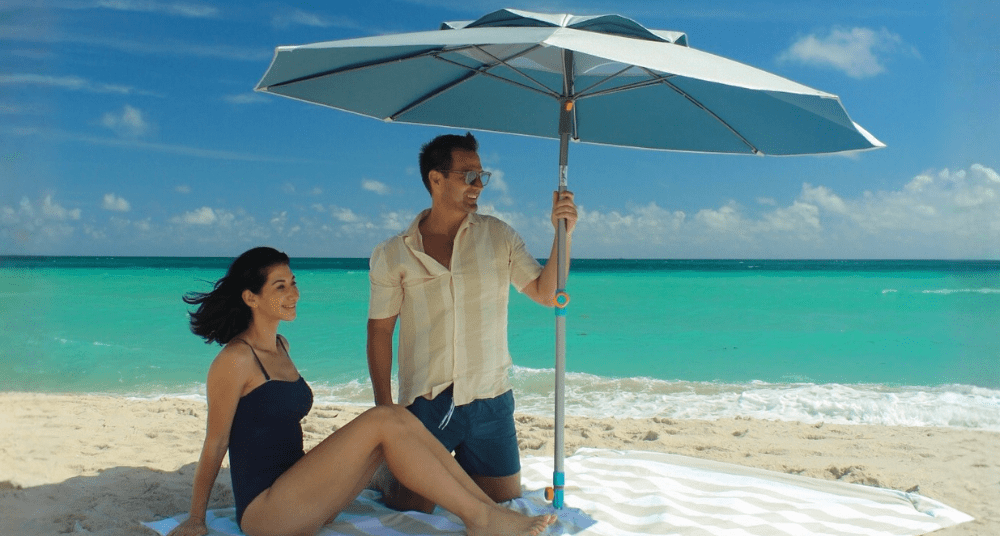
- The Handy canopy: Allows just 0.008% of UV rays to pass through.
SPF (Sun Protection Factor) measures how long skin takes to redden with sunscreen applied compared to bare skin.
The bottom line: You need both. Shade cuts the direct overhead attack; sunscreen covers the scattered and reflected light you can't avoid. Read more: "Beach umbrellas miss the mark on UV — here's what to look for"
Why the UPF Number on the Label Can't Help You
Here's the part almost nobody knows, and it's the reason this article exists.
The consumer UPF scale is capped at 50+. Under ASTM D6603, the labelling standard for sun-protective textiles, 50+ is the highest rating any fabric may carry — no matter how far past it the fabric actually performs. A canopy that blocks 98% and a canopy that blocks 99.99% can wear exactly the same label.
So if you're comparing shade, the UPF number is the wrong thing to compare. Ask for the UV transmission figure instead — the percentage that actually passes through. That number isn't capped, and it's the one that tells you what you're buying.
Why the Canopy Itself Matters (The "Transmission" Test)
Most people assume "shade is shade." But fabric density and weave are your first line of defense. Think of fabric like a sieve: a loose weave allows UV to pour through like water.
The "250x" difference. Comparing our independently lab tested canopy against the industry standard:
- A standard "UPF 50" umbrella allows about 2% UV transmission.
- Our silver-topped canopy allows 0.008% UV transmission.
- The result: A standard umbrella lets in 250 times more UV radiation than the Handy canopy.
Dual-action cooling (the silver top layer). Beyond blocking the burn, the reflective silver coating acts as a thermal barrier, bouncing both UV and infrared heat away rather than absorbing it. A dark canopy soaks up that heat and re-radiates it downward; a reflective one doesn't — which is why it feels noticeably cooler underneath than sitting under a dark-colored canopy.
Sunscreen is Still Non-Negotiable
Even under 99.99% blockage, UV finds you from the sides. Dry sand reflects roughly 15% of UV, and water reflects more.
A 2017 study in JAMA Dermatology put numbers on that. One group at a beach used only SPF 100 sunscreen; another used only a standard beach umbrella. After three and a half hours, 78% of the umbrella-only group had sunburn, against 25% of the sunscreen-only group. The lesson is not that umbrellas fail — it is that no single tool is enough. Shade handles the direct overhead sun; sunscreen handles the bounce.
- The plan: Use broad-spectrum SPF 30+ on all exposed skin and reapply as directed — especially after swimming or sweating.
- The gaps: Add a hat, sunglasses, and UPF clothing to close the spots people miss: shoulders, noses, ears, and the tops of feet.
For practical guidance, the American Academy of Dermatology is an excellent reference.
Steady Shade = Steadier Protection
If your canopy wanders with gusts, your coverage does too. Vented canopies release pressure so they don't balloon; deep, hammer-in anchors seat quickly and resist spin in sugar sand. A setup you can place once and trust keeps your protection where you intended it for the long haul of the day.
Wind-Powered Shade Might Not Be Consistent Shade
Sail- or wind-powered canopies look airy on breezy days, but the shade moves with the wind.
- The UV risk: When the breeze shifts — or drops altogether — coverage wanders, exposing shoulders and backs to direct sun.
- The density issue: "Lightweight" wind shades often achieve their weight savings with thinner, lower-density fabric. A looser weave can allow significantly more UV transmission than a heavy, silver-topped canopy.
For long beach days with kids, snacks, and naps, a vented, anchored canopy keeps your protection — and your temperature — stable. (Internal read: Wind safety: how to keep shade stable on gusty days)
What We Build Into Handy (So the Plan Actually Works)
- 99.99% UV blocked: Independently lab tested at 0.008% transmission — 250 times less UV than a standard UPF 50 fabric.
- Cooler by design: A reflective silver top layer bounces infrared heat away instead of absorbing it.
- Dense and sustainable: Tight-weave RPET fabric — each canopy made from about 80 recycled bottles.
- Wind stability: 10-second install with a deep-set, hammer-in steel anchor. No sandbags.
- Verified safety: Independently wind tunnel tested and compliant with ASTM F3681, the safety standard for beach umbrellas and anchors.
Stay cool, stay protected — explore the silver-topped Handy Umbrella & Anchor System.
Five Things Most People Miss (But Matter a Lot)
- Shift with the shadow: Keep your pole vertical for maximum wind safety; slide your chair or towel to follow the shade as the sun moves.
- Low glare beneath the canopy: A reflective outer plus a thoughtfully finished underside means bright protection without harsh glare on the eyes.
- Wet fabric isn't the same protection: Some fabrics transmit more UV when wet or stretched. Dense, quality canopies hold their rating better.
- Feet and ears get roasted: Sunscreen the forgotten zones, even in shade — tops of feet, ears, and the back of the neck.
- Stability is safety: A steady, anchored umbrella doesn't just hold UV coverage — it's safer for everyone around you.
A Simple Beach Protection Plan
- Set smart shade: Dense, reflective, vented canopy plus a deep-set anchor.
- Cover skin: Broad-spectrum SPF 30+, reapplied per label.
- Dress the gaps: Hat, sunglasses, UPF shirt.
- Mind the bounce: Reapply around noon and after swims — sand and water reflect UV.
- Stay comfortable: Hydrate, and adjust the angle as the sun moves.
Frequently Asked Questions
Does UPF replace sunscreen?
No. UPF stops the overhead UV at the fabric. Sunscreen protects exposed skin from the side-scatter — reflected UV that no umbrella can block.
What UPF rating should I look for?
Look past the rating. The consumer UPF scale is capped at 50+, so it can't distinguish a fabric that blocks 98% from one that blocks 99.99% — both wear the same label. Ask the manufacturer for the UV transmission percentage instead. A UPF 50 fabric passes about 2%. Ours was lab tested at 0.008%. Since you sit under it for hours, that gap is the whole decision.
Do I need sunscreen under an umbrella?
Yes. A 2017 study in JAMA Dermatology found that after three and a half hours 78% of people using only a beach umbrella were sunburned, against 25% of those using only sunscreen — the difference being reflected and scattered UV that no canopy blocks. Always apply broad-spectrum SPF 30+.
Are wind-powered beach shades good for UV protection?
They can be effective, but coverage shifts with the wind, creating gaps. Many lightweight shades also use thinner fabric with higher UV transmission. A fixed, silver-topped umbrella offers more consistent, denser protection.
Does fabric lose protection when wet or stretched?
It can. Stretching opens the pores of the fabric. Handy's high-density 160gsm weave is designed to hold its protection in coastal conditions.
About the Author
Written by Agnes, co-founder of Handy Beach Goods and a Florida mom of two. After one too many sunburns under flimsy shade, she set out to design a sun-safety system that actually works — combining a canopy lab tested at 0.008% UV transmission, a reflective silver top layer that bounces heat instead of absorbing it, and wind-stable anchors.
Safety & Compliance Notes
No shade is truly windproof. Always lower umbrellas in strong gusts or when unattended. Independently wind tunnel tested and compliant with ASTM F3681 for safer hold; follow local beach rules.