An honest comparison of the most popular beach blankets of 2026 — and why the two best-selling categories (Turkish-style cotton towels and budget nylon parachute blankets) consistently disappoint at the beach. Yes, our blanket is one of the options here. Where the other categories win, I say so. Last updated: September 2026.
The Verdict at a Glance
Two product categories dominate "beach blanket" search results: Turkish-style cotton towels and budget nylon parachute blankets. Neither was designed for beach use. Here's the honest breakdown:
- Cotton-towel-style blankets: Popular and stylish, but the cotton weave tends to feel firmer than buyers expect, and sand works into the fibers rather than shaking free — not the easy-clean experience the category markets.
- Budget nylon parachute blankets: Cheap and packable, but the fabric is closer to the outer shell of a camping tent than to a blanket, and it transfers heat straight through from the sand.
- Handy Stay-Put Beach Blanket — $49.99: Sand-pocket corner anchors (no stakes to lose), soft quick-dry microfiber top that sheds sand cleanly, waterproof underside, a reinforced center port for your beach umbrella, packs small, and made from recycled RPET. Named best beach blanket design by Travel + Leisure and best beach blanket under $50 by CNN Underscored.
Why Most "Beach Blankets" Aren't Built for the Beach
Search "best beach blanket" and you'll land on two dominant categories: aesthetic cotton towels marketed as blankets, and ultra-thin nylon parachute blankets at the budget end. Both photograph beautifully. Both fail at the beach in predictable ways.
A blanket that actually works on sand has to solve five problems that towels and tarps don't:
- Wind resistance — it stays flat without you weighing down every corner with a cooler and four pairs of shoes
- Sand release — the top fabric brushes off cleanly instead of trapping sand in the weave
- Waterproof underside — damp sand and morning dew don't soak through
- Practical anchoring — corner pockets or built-in weight, not separately-purchased stakes that get lost
- Umbrella integration — a center port so your shade and your surface work as one setup instead of two
Here's how the two most popular alternatives stack up — and where they fall short.
The Cotton-Towel Problem: A Towel Sold as a Blanket
Turkish-style cotton beach blankets are one of the most recognizable looks in beach lifestyle — an oversized woven cotton towel marketed as a beach blanket, typically priced around $50–$80. The aesthetic is genuinely lovely. The functional gaps are consistent:
- Texture: A flat cotton weave is firmer than it looks in photographs. Over a long afternoon on hard-packed sand, that's a comfort surface you feel.
- Sand release: The category markets easy shake-off, but sand works into cotton fibers and generally needs aggressive shaking — or a wash — to come out.
- No waterproofing: Cotton soaks through. Damp sand underneath transfers up within the hour.
- No anchoring: Nothing holds the corners. The first real gust folds it over on itself.
- Price-to-value: At $50–$80 next to a $15 beach towel, the premium is buying aesthetics rather than function.
What this category does well: the look, the packability, the dual use as a wrap or picnic throw. It's a beautiful Turkish towel. It just isn't a purpose-built beach blanket.
The Nylon Parachute Problem: Tent Fabric Sold as a Blanket
Budget nylon parachute blankets dominate the $20–$30 tier. They look like obvious value — 7′ × 7′, lightweight, packable, often under $25. The trade-offs show up on the first beach day:
- Material feel: It's parachute nylon — the same category of fabric as a tent flysheet. Functional, but nobody would describe it as a blanket.
- No insulation from hot sand: Thin nylon transfers heat directly. On a hot afternoon, sitting on it feels much like sitting on the sand itself.
- Stakes required — and easy to lose: These rely on corner stakes to hold position. Stakes get buried, bent, or left behind, and replacements are rarely sold by the brand.
- Limited waterproofing: Despite the plasticky feel, many are splash-resistant rather than waterproof. Damp sand still comes through over a few hours.
What this category does well: cheap, light, and genuinely fine for a picnic or the backyard. It just isn't built to hold up at a real beach day.
The Umbrella Hole: The Feature Almost Nobody Builds In
This is the one people don't think about until they've been to the beach without it.
You set up your umbrella. You lay out your blanket. And now you have two separate objects that don't quite work together — the pole comes down in the middle of your space, or you push the blanket off to one side and half of it sits in full sun. As the day goes on and you shift the blanket to chase the shade, you drag sand across everything.
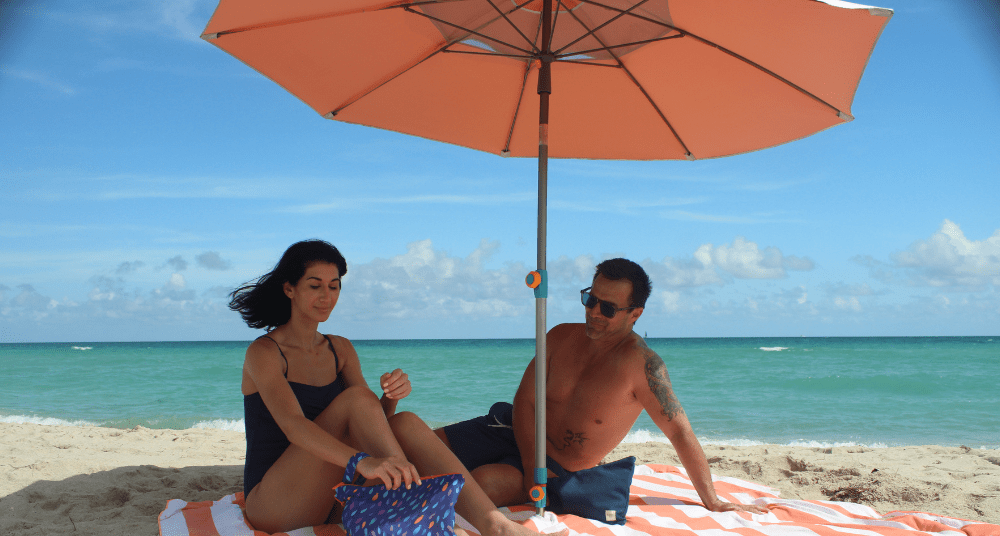
A center umbrella port — a reinforced opening in the middle of the blanket that the umbrella pole passes through — solves this properly. The pole anchors through the blanket into the sand below, and the two become a single setup. The shade sits centered over your space at midday (when it matters most) instead of beside it. And because the pole holds the blanket's center down, it adds another point of wind resistance on top of the corner pockets.
It's a small piece of construction and very few blankets have it, which is why "beach blanket with umbrella hole" is a search people actually type. If you already own a wind-resistant beach umbrella, a blanket with a center port is the piece that makes the whole setup coherent.
Worth saying plainly, because people ask: a port done properly costs you nothing on the days you leave the umbrella at home. Because the opening is bound and reinforced rather than simply cut, it lies flat, stays closed and is barely noticeable underfoot. You are not buying an "umbrella blanket" — you are buying a blanket that also takes an umbrella. We go through what separates a real port from a slit in beach blankets with an umbrella hole.
What an Actual Beach Blanket Solves
I co-founded Handy Beach Goods because none of the popular options actually worked at the beach. We'd buy the trending blanket, drag it to the sand, and end up frustrated — sand everywhere, the blanket curling up in the wind, no place for the umbrella, nowhere to stash a phone. The category needed something built deliberately.
Here's what the Handy Stay-Put Beach Blanket does differently:
- Size: 7′ × 7′ — comfortable for four adults, generous for a small family.
- Anchoring: Sand-pocket corners. Fill the pockets with sand and the blanket holds against wind without separate stakes. Nothing to lose, nothing to buy again.
- Top fabric: Soft quick-dry microfiber — the opposite of cotton-towel firmness, dries fast after a swim, and sheds sand cleanly instead of trapping it.
- Waterproof underside: A coated backing blocks damp sand and morning dew from seeping through.
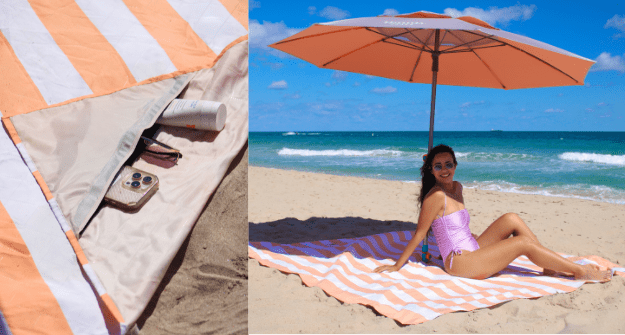
- Center umbrella port: A reinforced opening so a hammer-in umbrella anchor drives straight through the blanket into the sand — no offset shade, no awkward overlap.
- Corner storage pockets: The same corner pockets that hold sand double as storage for phones, keys, sunscreen and snacks.
- Packs small, lightweight: Folds into a compact bag that drops into a beach tote. Light enough to carry one-handed from car to sand — tarp-level packability without the tarp.
- Materials: Made from recycled RPET — roughly 40 post-consumer plastic bottles per blanket. Durable and machine-washable.
- Price: $49.99 — deliberately under $50.
Editorial recognition: Named best beach blanket design by Travel + Leisure and best beach blanket under $50 by CNN Underscored.
Quick Comparison Table
| Feature | Handy Stay-Put | Cotton-Towel Style | Nylon Parachute Style |
|---|---|---|---|
| Price | $49.99 | ~$50–80 | ~$20–30 |
| Size | 7′ × 7′ | ~6′ × 6′ | 7′ × 7′ |
| Umbrella hole | ✓ Reinforced center port | ✕ No | ✕ No |
| Anchoring | Sand-pocket corners (no stakes) | None (towel) | Stakes — easy to lose |
| Waterproof underside | ✓ Yes | ✕ No (cotton) | ⚠ Splash-resistant |
| Sand release | ✓ Microfiber sheds sand cleanly | ✕ Sand embeds in cotton | ⚠ Variable |
| Feel underfoot | ✓ Soft quick-dry microfiber | ⚠ Firm cotton weave | ⚠ Thin parachute nylon |
| Storage pockets | ✓ Corner pockets | ✕ No | ✕ No |
| Packability | ✓ Packs small, lightweight | ✓ Folds like a towel | ✓ Packs small, lightweight |
| Materials | Recycled RPET | Turkish cotton | Parachute nylon |
Frequently Asked Questions
What is the hole in the middle of a beach blanket for?
It's a reinforced port that a beach umbrella pole passes through, so the umbrella anchors into the sand directly beneath the center of the blanket. That keeps the shade centered over your space rather than off to one side, and the pole holds the blanket's middle down as an extra point of wind resistance. You don't have to use it — a properly reinforced port stays flat and closed, so the blanket works exactly as a normal blanket on umbrella-free days.
How do you keep a beach blanket from blowing away?
The most reliable method is built-in sand pockets at the corners — you fill them with sand on arrival and empty them when you leave, with nothing separate to carry or lose. Stakes work but tend to get buried or left behind. Weighing the corners with shoes and coolers works until you need the cooler.
Are sand-free beach blankets real?
No fabric is completely sand-free, and any product claiming that is overpromising. What's achievable is sand release: a tightly woven quick-dry microfiber lets sand sit on the surface so a shake clears it, rather than working into the fibers the way cotton does. We answer this one at length in is there such a thing as a sand-free beach blanket?
What size beach blanket do I need?
7′ × 7′ comfortably fits four adults or a small family with room for a cooler and bags. Anything under 6′ × 6′ is realistically a two-person blanket once you've put anything down on it.
The Honest Verdict
If you want a beautiful Turkish towel, the cotton-towel category delivers exactly that — just don't expect it to behave like a purpose-built beach blanket. If you want a $20 picnic tarp for occasional use, the nylon parachute category will get you through. Neither is wrong, exactly. They just aren't built for the problem most beachgoers actually have.
If you want a blanket that holds against wind without stakes, sheds sand cleanly, blocks damp sand from underneath, takes an umbrella pole through the middle, and lasts more than one season — that's why I built the Handy Stay-Put Beach Blanket. $49.99, recycled RPET.
Shop our Ultra-Comfort Beach Blankets
About the Author
Written by Agnes, co-founder of Handy Beach Goods and a Florida mom. We design our gear in Florida and test it on the beaches we actually use.