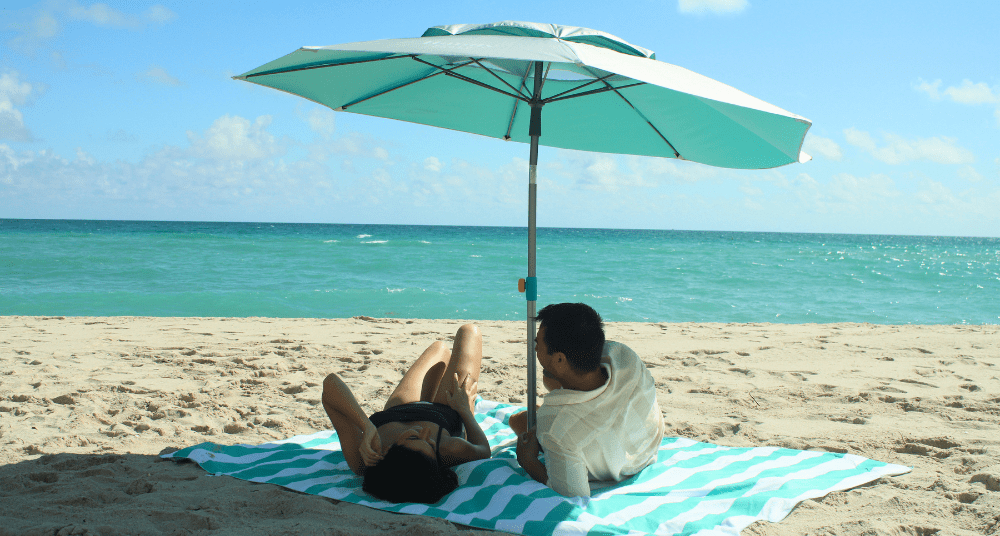
30-Second Summary: Most beach setups are a pile of loose gear that drifts apart all afternoon. The fix is to think of it as a structure — a floor that stays flat and a roof that stays anchored, connected to each other. Here's how to build a base camp that holds its shape from the moment you arrive.
We've all had the chaotic version of a beach day. The towel blows over on itself, the umbrella leans further left every hour, and everything you own is full of sand within ten minutes. It feels less like a break and more like a logistics problem you brought to the beach with you.
The difference between that and a genuinely relaxing setup isn't more gear. It's treating what you bring as a structure rather than a pile.
The Concept: A Floor and a Roof
A good beach setup works like a small building. You need a solid floor, a reliable roof, and — the part almost everyone misses — a connection between the two.
1. The Floor: Why a Towel Isn't Enough
Towels are for drying off. They were never designed to be furniture. Used as a ground surface, a towel bunches up, traps heat underneath, and lets sand work into the weave until you're sitting on more of it than you started with.
A proper beach blanket does three things a towel can't:
- It defines the space. A 7ft × 7ft surface visually marks out your family's spot — which matters more than it sounds on a crowded beach, both for the kids and for the people setting up next to you.
- It holds its own corners. Ours uses sand-pocket corners: fill them on arrival, and the blanket stays flat without stakes to lose or a cooler parked on every edge. Empty them when you leave.
- It sheds sand instead of trapping it. A quick-dry microfiber top lets sand sit on the surface so a shake clears it, rather than working into the fibers the way cotton does.
2. The Roof: Shade That Doesn't Move
The roof has two jobs: block the sun properly, and stay exactly where you put it.
On the first, fabric density and lining do the work. Our canopy was independently lab tested at 0.008% UV transmission — 99.99% of UV blocked — with a silver top layer that reflects infrared heat rather than absorbing it, so the air underneath stays cooler than it does under a dark canopy.
On the second, the anchor decides everything. The Handy Beach Umbrella & Anchor System drives a steel stake two feet into the sand in about ten seconds — past the dry loose surface layer into the damp packed sand below, which is the layer that actually holds. It's compliant with ASTM F3681, the safety standard for beach umbrellas and anchor devices, verified by independent wind tunnel testing.
(For how each anchor type performs — augers, sandbag bases, hammer-in steel — see our guide to wind-resistant beach umbrellas.)
The Part Almost Nobody Gets Right: Connecting Them
Here's what turns two separate objects into one setup.
Our beach blanket has a reinforced center port — an opening in the middle that the umbrella pole passes through. You drive the anchor down through the blanket and into the sand beneath it.
Three things happen at once:
- The shade sits centered over your space instead of off to one side, so you're not shuffling the blanket every hour to chase it.
- The umbrella pins the blanket's middle down, which combines with the corner pockets to give you four edges and a center all held at once.
- There's no gap between the shaded area and the clean surface — so when you stand up to reach the cooler, you're not putting a foot onto hot sand.
It's a small piece of construction and very few blankets have it. It's also the difference between gear that works together and gear that happens to be in the same place.
Building Your Base Camp: The Short Version
- Pick your spot and lay the blanket out flat, oriented so the center port sits where you want the shade.
- Fill the corner pockets with sand. Do this before anything else — it's much easier before there's a cooler on it.
- Drive the anchor through the center port to full depth, before opening the canopy. An open canopy catches wind while you're still working.
- Lock the pole in and open the canopy, angling it into the wind so gusts spill off the top.
- Sit down. That's the whole thing.
Planning Ahead?
If you're booking a trip — 30A, the Outer Banks, the Jersey Shore, or a season down south — look at your gear before you look at your dates.
Is the umbrella rusted from last year? Is your "blanket" still an old bedsheet? Sorting it out now means that on the first genuinely warm day you're not scrambling, you're already set up.
Building a full kit from scratch? The Ultimate Beach Packing Checklist covers everything else worth bringing.