30-Second Summary: If you're driving to a warm beach this winter, you have the one advantage most travelers don't: space. That changes the math completely — a week of resort rentals costs more than the gear itself, and hauling it costs you nothing but trunk room. Here's what to load, what to swap from your summer list, and what winter coastlines do differently.
Driving down for the whole season, not a week? Different math entirely — see The Snowbird's Beach Kit.
While most of the country is bracing for snow, a smarter group is loading the car and pointing it south.
As Floridians, we can tell you that a beach day in December isn't a beach day in July — the sun sits lower, the water is colder, and the wind is noticeably stronger. But if you're driving, you start with an advantage that flyers don't have, and most people waste it.
1. Driving changes the whole calculation
People who fly agonize over what fits in a suitcase and usually end up renting everything when they land. You don't have that problem. You have a trunk.
Which makes the rental question much simpler than it looks.
Resort and beach-club rentals commonly run $50 to $100 a day for two chairs and an umbrella. Over a seven-day trip that's $350 to $700 — for gear you hand back at the end, that someone else chose, set up where they wanted it.
Bringing your own costs you some trunk space and nothing else. For a family, or for any trip longer than about three days, it isn't a close call.
The less obvious benefit is where you can go. A rented setup ties you to the resort zone. Your own gear means the quiet stretch of coast twenty minutes up the road is an option — and on a crowded holiday week, that's the difference between a good trip and a great one.
2. Loading the car
A few things worth knowing before everything goes in:
- Long items go in first, along the side. An umbrella in a sleeve wants to lie flat down one edge of the trunk, not across the top where it stops the lid closing.
- Keep the beach bag last in, first out. If you arrive before check-in — which happens constantly on a drive down — you want swimsuits, sunscreen and towels reachable without unpacking the whole car. A beach hour beats a lobby hour.
- Flat-packing items are free real estate. A blanket that folds flat costs almost nothing in space. A chair costs a lot. Prioritize accordingly.
- Buy the bulky consumables when you arrive. Coolers, cases of water, extra towels, sunscreen by the bottle — all cheaper locally and all a waste of the drive.
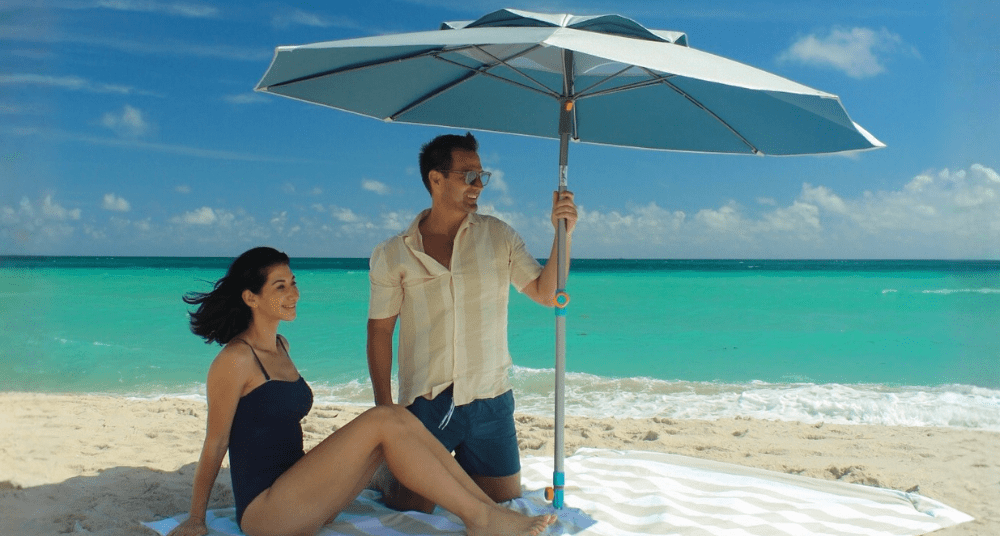
Our Umbrella & Anchor System packs the anchor, pole and canopy into one sleeve, which is a single long item rather than three loose pieces migrating around the trunk for 900 miles.
3. The winter wind factor
Know what you're driving into. Between November and March you're arriving in the windy season, and most visitors don't realize it until the first afternoon.
In Florida, the stronger winter wind comes from the cold fronts that push through from late fall into spring. Further south, in the Bahamas and the Caribbean, it's the steady trade winds. Either way you get sustained onshore wind, not the gentle afternoon sea breeze of a July morning.
This is why the umbrella bought at a tourist shop on day one so often fails within the hour. That gear is built for calm conditions and a short holiday, and winter is neither.
What actually holds: a deep-set anchor rather than a screw-in base or sandbags, steel rather than plastic, and some evidence the thing has been tested. Ours has been independently wind tunnel tested and is compliant with ASTM F3681, the safety standard for beach umbrellas and anchors, at wind speeds up to 30 mph. Longer explainer here: Beach Umbrella Wind Safety & ASTM Standards.
4. Check the rules where you're going
This catches road-trippers more than anyone, because you pack at home and find out on the sand.
Beach rules in the US are set at the town or county level, not the state level, so they change from one stretch of coast to the next. Tents and canopies are banned outright on a growing number of beaches, and the list gets longer most seasons. Umbrella height limits are common. Some towns require anchoring. Belleair Shore, Florida went furthest and banned beach umbrellas entirely.
Ten minutes on your destination's town website before you load the car will save you hauling something 900 miles that you aren't allowed to put up. We keep a running guide: beach canopy and tent bans, rules and fines.
5. The winter sun myth
There's a persistent idea that because the air is 75°F instead of 95°F, you won't burn.
You will. South Florida and the Caribbean sit in the moderate-to-high UV range through the winter — typically a midday index of 4 to 7 in January. That's below an August peak and still comfortably enough to burn unprotected skin in under an hour. The cool breeze makes it worse rather than better, because it removes the discomfort that would normally send you into the shade.
Broad-spectrum SPF 30 or higher is still non-negotiable, and so is real shade between 10am and 2pm. Our canopy was independently lab tested to block 99.99% of UV.
6. What to swap out of your summer list
Start from our Ultimate Beach Packing Checklist and make these four changes for a winter trip:
- Cotton tee → rash guard. The air is warm but the water is cold. A rash guard keeps you warmer in the water and adds sun protection on top.
- Add a sunset layer. Winter days are short. Once the sun drops around 5:30pm the beach gets chilly fast — a windbreaker or dry hoodie is the difference between staying for sunset and leaving before it.
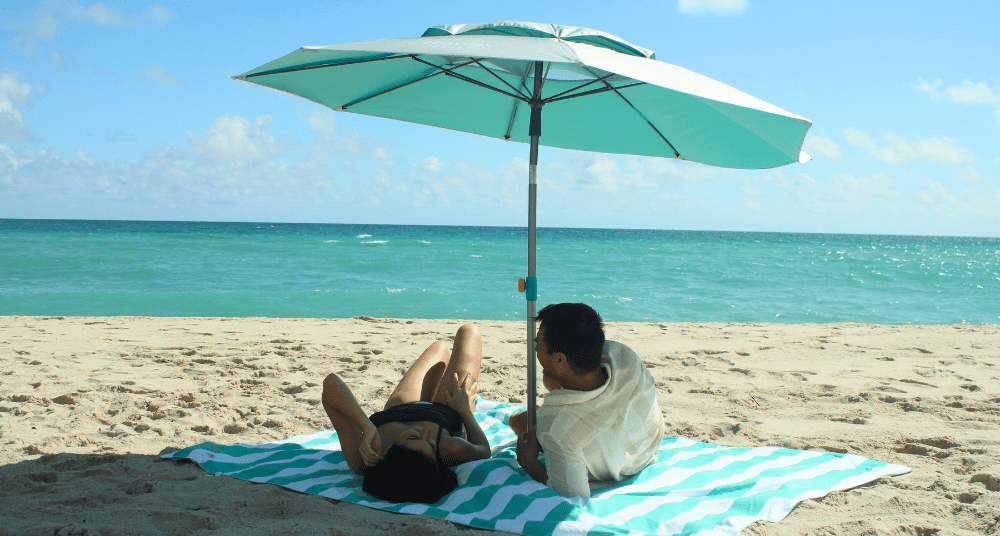
- Thick towels → quick-dry. In cooler humidity, heavy cotton takes forever to dry, and a damp towel in a car for a week is its own problem. Our Oversized Waterproof & Sand-Repellent Beach Blanket ($49.99) sheds water and sand instead of absorbing them, and folds flat.
- Add a dry bag. The Wet/Dry Beach Wristlet (from $22) keeps a phone, keys and cards dry and sand-free — useful at the beach, more useful when you're living out of a car.
- Throw in a sand glove. The Sand Remover & Sunscreen Applicator Glove ($12.99) is a $13 item that keeps a week's worth of sand out of a car you have to drive home in.
Traveling to visit family this winter?
Don't show up empty-handed. Full guide, organized by who you're shopping for: Best Beach Gifts 2026.
Ready for the warm up?
Whether you're driving to Key Biscayne, Gulf Shores or the Outer Banks, the goal is the same: relax. Don't let gear failure or a badly packed car eat into vacation time you waited all year for.
Pack smart and enjoy the sun.
Safe travels,
Agnes
FAQ: Winter Beach Road Trips
Is it cheaper to rent beach gear or bring my own?
If you're driving, bringing your own wins for almost any trip over about three days. Resort rentals commonly run $50 to $100 a day for two chairs and an umbrella, so a week is $350 to $700 — more than the gear costs, for equipment you return.
Is the sun strong in Florida in December?
Strong enough to burn. The midday UV index in South Florida and the Caribbean sits in the moderate-to-high range through the winter, which will cause a sunburn quickly between 10am and 2pm even though the air feels mild.
Is it actually windier at the beach in winter?
Along the coast, generally yes. In Florida the cold fronts that move through from late fall into spring bring sustained onshore wind; further south it's the trade winds. Either way it's stronger than a typical summer sea breeze, which is why cheap umbrellas fail so quickly on winter trips.
Can I use a pop-up tent or canopy instead?
Sometimes — but check your destination first. Tents and canopies are banned on a growing number of US beaches, while umbrellas are permitted in considerably more places. Rules are set town by town, so confirm before you pack one.
What should I look for in a beach umbrella for windy conditions?
A deep-set steel anchor that hammers into the sand rather than a screw-in base or sandbags, a reinforced rib frame, and independent testing against the ASTM F3681 safety standard. Be skeptical of anything sold as "windproof" — no shade is.
I'm driving down for the whole winter, not a week. Is this the right guide?
Not quite — a four-month stay has completely different gear math than a one-week trip. See The Snowbird's Beach Kit instead.
About the author: Agnes is the co-founder of Handy Beach Goods. She started the company in Florida after one too many umbrellas went airborne on a family beach day, and has spent years testing beach gear with two kids in tow.