30-Second Summary: At Florida and Caribbean resorts, renting two beach chairs and an umbrella commonly runs $40 to $80 a day. Over a 5-day trip that's $200 to $400. Over a snowbird season it's several thousand — and at the end you hand it all back. Here's the math, plus why bringing your own gear also gets you a better spot, a cleaner setup, and an umbrella that actually stays in the sand.
You booked the flights, found the hotel, mapped out the trip. But there's a fee waiting for you on the sand that rarely makes it into the budget.
The beach rental trap.
If you've been to Florida or the Caribbean recently you know the drill: two chairs and a sun-faded umbrella, $40 to $80 for the day depending on the resort. Here's why a lot of regular beachgoers have quietly stopped joining that line.
1. The Math: It Pays for Itself in About Three Days
Take a standard 5-day beach trip. At $60 a day for a resort setup, that's $300 just to sit in the shade. At the end of the week, you give it back.
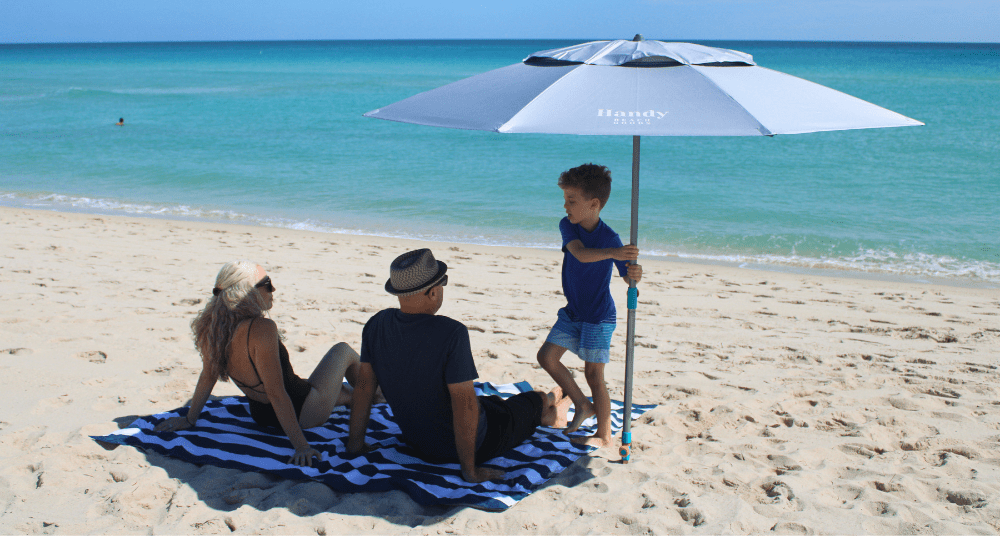
The Handy Umbrella & Anchor System costs about the same as two or three days of rental. By Wednesday of a one-week trip, you're ahead — and you own it.
2. The Snowbird Math Is Where It Gets Absurd
If you're south for the season rather than the week, run the same numbers again.
A snowbird season runs roughly November to March. If you get to the beach three or four times a week — which is usually the whole point of going — that's somewhere between 50 and 65 beach days.
| Trip length | Beach days | Rental cost at $60/day |
|---|---|---|
| Long weekend | 3 | $180 |
| One-week vacation | 5 | $300 |
| Two weeks | 12 | $720 |
| A snowbird season | 50–65 | $3,000–$3,900 |
A full beach setup — umbrella, anchor and blanket — runs around $200 and lasts for years. Against a single season of rentals, that's not a close call.
And the daily friction matters as much as the money. Renting means going to the kiosk, waiting, paying, and sitting where they put you. Every single day, for four months.
For the full picture of what a season down south actually demands of beach gear, see The Snowbird's Beach Kit.
What if you're flying, not driving?
Fair question — a full-size beach umbrella isn't carry-on luggage, and this is where a lot of people assume renting is the only option.
Two ways round it. If you're heading somewhere for a season or a long stay, ship your gear to the address you're staying at and have it waiting when you land. You skip the airline entirely, and it costs a fraction of what you'd spend on rentals over the same period.
For shorter trips, it travels as checked oversize sporting equipment, the same way golf clubs or skis do — worth checking your airline's dimensions and fees first, because they vary a lot.
And to be straight about it: for a two- or three-day trip where you're flying, renting probably does win. It's the longer stays where shipping ahead pays for itself several times over.
3. The Waitlist and the Back Row
Resort rentals are finite, and on a busy week they go early. If you're not down at the attendant by eight, you're on a waitlist or you're in the back row, looking at the backs of other people's heads instead of the water.
Bring your own and the whole beach opens up. Set up at the water's edge where you can see the kids, or walk five minutes down and find a quiet stretch away from the resort cluster entirely. You're on your own schedule.
4. The "Base Camp" Upgrade
Resort loungers are stiff plastic, shared by everyone who came before you, and paired with a small scratchy hotel towel.
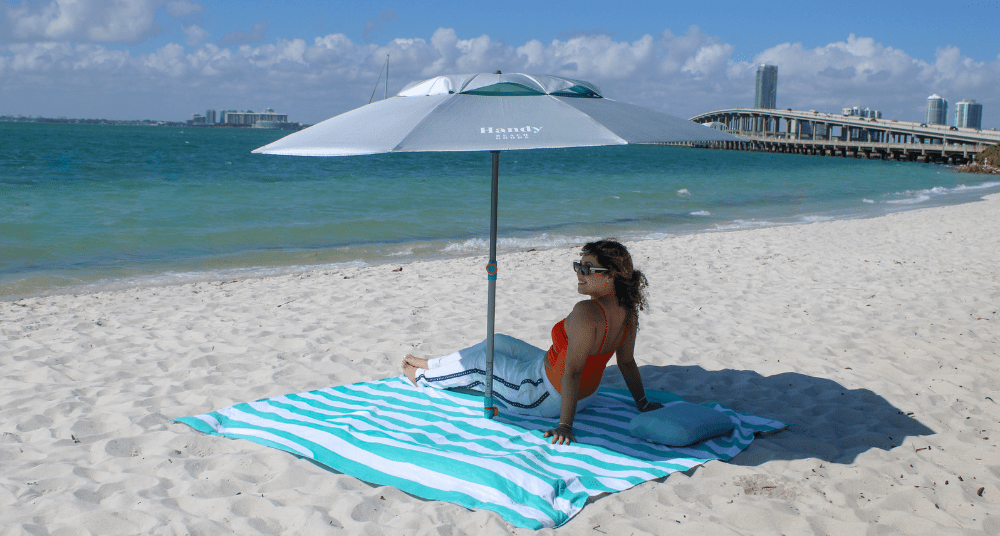
Pair your umbrella with a Handy Beach Blanket and you get a 7ft × 7ft sand-repellent surface for the whole family, with a waterproof underside and a reinforced center port that the umbrella pole passes straight through. One setup instead of two objects that don't quite work together.
It also takes care of the other half of the rental bill. Most of what a resort charges for is chairs, and a blanket big enough for four replaces the loungers entirely — which is what most families end up preferring anyway, since nobody in the group is stuck sitting upright in plastic while everyone else sprawls.
💡 Pro Tip: The Carry Hack
Worried about hauling it? The umbrella comes in a comfortable carry bag. Clip your Handy Wristlet — phone, keys, room card — directly to the bag strap, and you've got the whole setup hands-free from car to sand.
5. The Quality Difference
Worth being fair here: a well-run beach service anchors properly. Commercial operators use heavy-duty augers that go about two and a half feet into the sand, and many install them with a power driver attachment — essentially a drill — because hand-twisting dozens of them before the first guests arrive isn't practical. That's real anchoring, and it's why a good service's umbrellas stay up on a breezy day.
But look at what it takes: a commercial-grade anchor, a power tool, and a crew to run it. That's the standard a consumer umbrella has to meet with none of those things.
The Handy system gets there with a slide hammer built into the lower pole. You stand slide the handle down a few times, and the steel anchor drives two feet into the sand — past the dry, loose surface layer into the damp packed sand that actually holds. About ten seconds. No drill, no separate tool, nothing extra to carry. It's compliant with ASTM F3681, the safety standard for beach umbrellas and anchor devices, verified by independent wind tunnel testing — held at increasing speeds up to 30 mph, then at 30 mph for a further 30 minutes, without failing.
The canopy is the part you can't assess by looking. UV breaks fabric down over time — that's true of any canopy, ours included, which is exactly why we sell replacement canopies rather than replacement umbrellas. The difference is that you know how old yours is and when you last replaced it. With a rental, you don't, and there's no way to tell by eye. Ours was independently lab tested at 0.008% UV transmission — 99.99% of UV blocked — with a silver top layer that reflects infrared heat rather than absorbing it.
(More on how the anchor types actually compare: our guide to the best beach umbrella for wind.)
When Renting Actually Makes Sense
To be fair about it — renting is the right call sometimes.
If you're flying somewhere for two or three days, if it's a one-off trip you won't repeat, or if you genuinely can't manage carrying gear, paying the daily rate is reasonable. The math above only turns decisively once you're past about three beach days, or once you're going back to the same coast more than once.
The break-even is roughly a long weekend. Everything beyond that is where owning wins.
The Verdict: Take Control of Your Beach Day
Your travel budget should go toward sunset dinners and boat trips, not renting shade by the day. Bringing your own wind-resistant setup saves money from about day three, skips the queue entirely, and gets you the spot you actually want.
For a snowbird, it isn't even a calculation. It's a season of rental fees against a one-time purchase that outlasts several of them.
Putting a travel setup together? The Ultimate Beach Packing Checklist covers everything else worth bringing.
Ready to stop paying resort rates?
Buy direct and your warranty is registered automatically — 5 years on the anchor, 2 on the canopy — with replacement canopies, anchors and hardware available whenever you need them. It's built to be maintained, not replaced.
About the Author
Written by Agnes, co-founder of Handy Beach Goods and a Florida mom. After years of paying resort rates for flimsy beach chairs, she decided to build a better way for families to enjoy the beach.