30-Second Summary: Wind-powered canopies like the Shibumi Shade use the breeze to hold the fabric aloft. The brand states it floats on as little as 3 mph, and every shade now ships with a Wind Assist that anchors the corners with sandbags for calmer days. The trade-offs are real ones: you pitch it facing the wind, the shade drifts with the breeze as well as the sun, the fabric makes a sound above your head, and in towns that restrict canopies and tent-style structures it may not be permitted. If you want shade that behaves the same in strong wind and dead calm, goes up in about ten seconds with nothing to fill, and is allowed in more places, a wind-tested center-pole umbrella is the more versatile buy.
Shibumi Shade vs. an Anchored Beach Umbrella: An Honest Comparison
If you’re about to spend a few hundred dollars on beach shade, you’re not just buying fabric. You’re buying whether the afternoon is relaxing or a low-grade battle with your equipment.
The live debate in beach gear right now is between traditional center-pole umbrellas and the newer category of wind-powered shades, of which the Shibumi Shade is the best known. Wind shades use the ocean breeze to hold a curved canopy aloft. It’s an elegant idea, and where the conditions suit it, it works well.
Here’s a realistic look at where each one fits. We make umbrellas, so read this knowing that — but we’ve tried to be straight about where a wind canopy is the better tool, and every figure we give for their product is quoted from their own published listings.
The design uses wind. That isn’t a criticism, it’s the premise.
The category was developed on the North Carolina coast, where the wind runs steadily through most of the day. In that environment a wind-powered canopy holds its shape and does its job beautifully.
Shibumi states the canopy floats on “as little as 3 mph of wind,” and every shade now ships with a Wind Assist accessory for calmer days. In their words, it “attaches to the corners of your Shibumi Shade canopy, anchoring each side with sandbags to create a tent-like shape,” and is “best for those times on the beach when there’s barely a breeze.”
That’s a sensible answer to the problem. It’s also worth seeing it for what it is: on a still morning, the solution is filling sandbags — which is the chore we built our system to remove.
Where you go matters, then:
- The Florida Gulf Coast: Gulf mornings are often still and humid, with the breeze arriving later in the day if at all.
- New England and Cape Cod: the weather shifts fast. A good morning breeze can drop by early afternoon, which is the hottest part of the day and exactly when you want the shade.
- Southern California: the Pacific breeze is reliable, but beaches from Laguna to San Diego are packed in July, and a 150 sq ft canopy claims a lot of sand.
It has to face the wind
Shibumi’s own setup instructions read: “Plant the poles in the sand, fill the anchor, face the wind, and relax.”
That last part is the one worth thinking about before you buy. A wind-powered canopy is pitched relative to the wind direction — it has a front. Beach wind doesn’t hold one direction all day; an onshore morning breeze commonly swings through the afternoon as the land heats up. When it moves, your shade is still oriented to where the wind used to be.
A center-pole umbrella has no front. It goes up the same way regardless of which way the air is moving, and nothing about the afternoon asks you to re-pitch it.
How to actually compare UV protection
This is the part most shade comparisons get wrong, and it’s simpler than it looks.
Nearly every serious beach shade is UPF 50+, and you’ll often see “blocks 98% of UV” quoted alongside it. Here is what that actually means: UPF 50 is defined as letting 1/50th — 2% — of UV through. So “98% blocked” isn’t a result anyone achieved. It’s the arithmetic of the rating. Under ASTM D6603, 50+ is also the top of the US consumer labelling scale, which is where every good fabric lands and where the comparison stops being useful.
The number that still tells you something is UV transmission — the measured percentage that actually passes through a specific piece of fabric. We had ours measured: 0.008% transmission, which is 250 times less than the 2% a UPF 50 fabric is permitted to pass.
We won’t pretend that’s the reason to choose one shade over another for most people. If you’re sitting under good fabric, you’re under good fabric. But it is a fair question to ask any manufacturer, and the answer tells you something either way: whether they have actually tested their own product, or are simply repeating what the label allows. Ask for the transmission percentage, and ask who measured it.
Why people report getting burned under shade
You’ll find reviews from people who got sunburned under a wind shade. We’re not going to tell you that proves the fabric failed — people get sunburned under umbrellas too, from UV reflecting off sand and water. Dry sand bounces back roughly 15% of what hits it, and no overhead shade stops that.
There is a mechanical difference worth understanding, though. Any shade moves: the sun crosses the sky at roughly 15 degrees an hour, so with an umbrella you shift your chair every hour or two. The point isn’t that one moves and the other doesn’t — it’s that with a fixed pole you can see exactly where the shadow went and predict where it’s going next.
A canopy held up by wind moves for two reasons at once: the sun, and the breeze. The second one you can’t anticipate. And because the air still feels cool, it’s easy not to register that you’ve drifted out of the shade. (More on this in fake shade: why you can burn under an umbrella.)
Two more things people don’t expect
The sound
Most people go to the beach for the sound of the water. Any large fabric span held in moving air makes noise, and a wind-powered canopy sits directly above your head.
Shibumi has addressed this head-on, which tells you it’s a real consideration rather than a complaint we invented. Their current canopy is described as having “a softer, more pleasing sound at all wind speeds” and as significantly reducing loud flapping in high winds. By their own description, that’s a quieter canopy — not a silent one. Some people never register it; others find four hours of it changes the character of the afternoon. It’s worth standing under one before you buy.
The footprint, and where you’re allowed to use one
The Shibumi Classic is published at 150 square feet of shade for up to eight people. That’s generous if you’re a group of eight, and a lot of sand to claim on a crowded Saturday if you’re two. An umbrella shades roughly the area you’re actually sitting in.
It can also matter legally. A number of beach towns now restrict large canopies and tent-style shade structures during the summer season — Rehoboth Beach, Delaware and Myrtle Beach, South Carolina among them — with the stated reasoning usually being that large fabric structures obstruct lifeguards’ view of the water. Whether a specific product falls under a specific ordinance is a question for that town, and the rules are set locally and change most seasons. Check your destination before you buy: beach canopy and tent bans, rules and fines.
Are Shibumi shades banned? What the rules actually say
This is one of the most common things people search about wind-powered shades, so here is the straight answer: we are not aware of any beach that bans the Shibumi Shade, or any other shade, by brand name — and you should be sceptical of anyone who tells you otherwise. What exists is something broader and considerably more boring.
Coastal towns write their shade ordinances by structure type and size, never by brand. The rules that catch large fabric shades tend to share three features:
- A size cap — a maximum diameter or footprint
- A restriction on tent-style and canopy structures: fabric spanning an area rather than sitting on a single pole
- An exemption for a standard center-pole umbrella below a stated diameter
Myrtle Beach, for example, permits umbrellas up to 7½ feet across through peak season while restricting larger canopies and tent-style structures. Rehoboth Beach, Delaware restricts tents and canopies and requires shade to be anchored so it cannot move in the wind. The stated reasoning in most of these ordinances is lifeguard sightlines rather than anything about a particular product.
So the useful question isn’t “is this brand banned.” It’s “does my beach allow a shade structure of this type and size, this season?” — and that is answered on the town’s own website, not by any manufacturer, including us. Rules change most seasons, and a town that allowed something last August may not this one.
Where this does affect the comparison: a center-pole umbrella is the configuration those “umbrellas only” exemptions are written around, which is why it tends to be permitted in more places. That is a consequence of its shape, not a claim about anyone else’s product.
Looking for a Shibumi Shade alternative?
People searching for an alternative are usually after one of three specific things. Worth identifying which one applies to you, because the answer differs.
- Shade that doesn’t depend on the breeze. A canopy held up by airflow behaves differently when the airflow drops, which is why the category’s own answer for calm days is a sandbag accessory. If your mornings are often still, as they are on much of the Gulf Coast and in New England, a structured umbrella holds its shape regardless — with nothing to fill.
- Shade that doesn’t have to face a direction. A wind-powered canopy is pitched into the wind and performs relative to it. An umbrella has no front, so a shifting afternoon breeze doesn’t ask you to re-pitch anything.
- Predictable shade position. A fixed canopy moves only with the sun — about 15 degrees an hour — so you can see where the shadow is heading. A wind-held canopy moves with the breeze as well.
If one of those three is what sent you looking, a structured, anchored center-pole umbrella is the direct answer — it solves all three at once, which is why it’s the usual destination for people leaving the category.
And if none of them applies — if you have reliable wind, you’re shading a large group, and you have the space — then the sail is the right tool for your beach and you should buy one. An alternative is only better if it solves a problem you actually have.
If you’re comparing one wind-powered shade against another
Plenty of people arrive here weighing two sails against each other rather than a sail against an umbrella. The honest advice: the choice between similar wind-powered canopies matters far less than the question underneath it — does your beach reliably have wind during the hours you’re actually there?
If yes, most products in the category will do the job and you can choose on price, size and colour. If no, which model you pick is beside the point, because the mechanism is the constraint rather than the brand.
Why a center-pole umbrella is the more versatile buy
Whether you’re on the windy Outer Banks or a calm stretch of Gulf coast, the advantage of a good umbrella is that it doesn’t care which one you’re on.
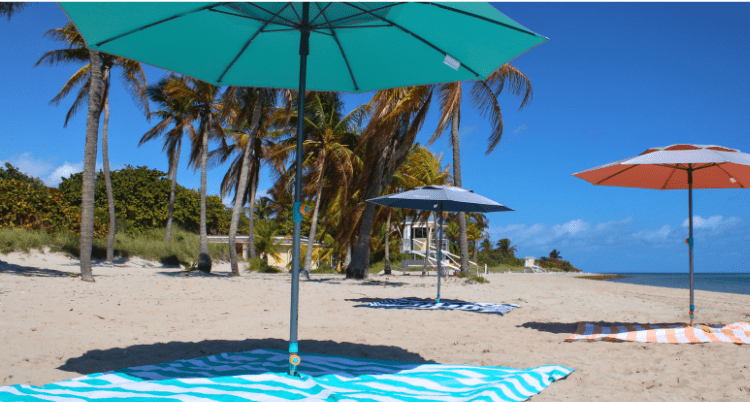
- It works in wind and in dead calm. It goes up the same way on a windless Cape Cod morning as it does when the afternoon gusts arrive, and there is nothing to fill either way. The system has been independently wind tunnel tested and is compliant with ASTM F3681, the safety standard for beach umbrellas and anchors. In that test it was held at increasing speeds up to 30 mph, then at 30 mph for a further 30 minutes, without failing. (We explain what the standard actually covers in the ASTM beach umbrella wind safety guide.)
- No orientation to get right. There’s no front to point into the breeze, so a wind shift during the afternoon changes nothing about your setup.
- The shade moves predictably. The shadow tracks the sun and nothing else, so you reposition on your own schedule rather than the wind’s.
- It’s permitted in more places. A center-pole umbrella is the configuration that “umbrellas only” ordinances are written to allow. A small number of towns regulate umbrellas too, so it’s still worth ten minutes on your destination’s website before you travel.
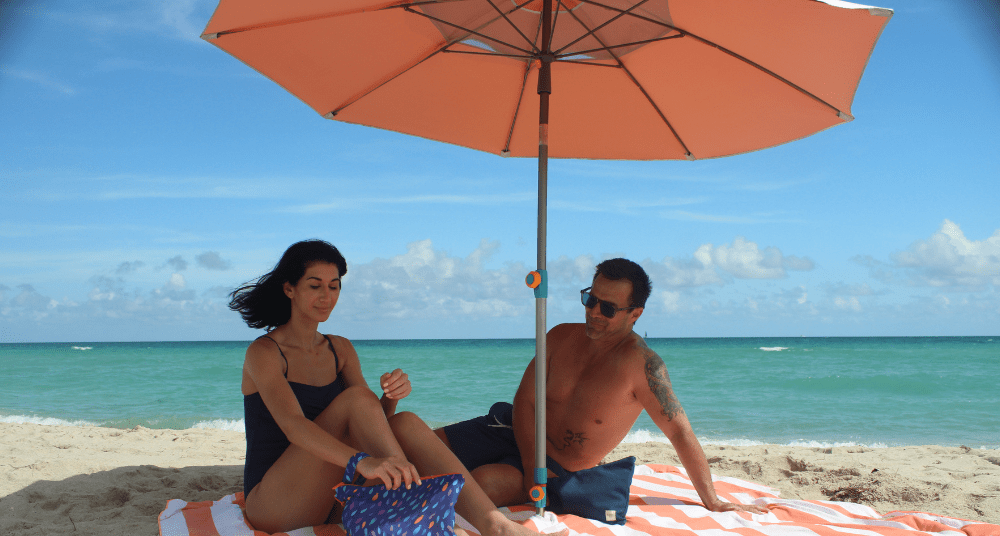
- Ten-second setup. Ours uses an integrated steel slide hammer: slide the handle down, and the anchor drives two feet into the sand. No digging, no sandbags, no separate mallet, and it comes out in about five seconds.
If you’re comparing umbrellas rather than categories, our guide to the best beach umbrella for wind covers the four anchor types, and the sand anchor guide covers what holds in which sand.
The final verdict
If you’re a group of eight on a reliably windy coast, a wind canopy is a good tool and we’d tell you to buy one.
For most people — a couple, a family, anyone who goes to more than one beach — a structured, anchored umbrella is the more versatile investment. It works whatever the wind is doing, there’s nothing to fill on a still day, the shade behaves predictably, it’s allowed in more places, and it goes up in about ten seconds.
👉 Shop the Handy Umbrella & Anchor System
Frequently Asked Questions
Do wind-powered beach shades need wind to work?
Largely, yes — that’s the design. Shibumi states its canopy floats on as little as 3 mph of breeze, and includes a Wind Assist accessory that anchors the canopy corners with sandbags for days when there’s barely any. So a calm morning isn’t a dead end; it just means filling sandbags. An anchored umbrella goes up identically whatever the air is doing.
Does a Shibumi Shade have to face the wind?
Their published setup is “plant the poles in the sand, fill the anchor, face the wind, and relax,” so yes, it’s pitched relative to wind direction. Beach breezes commonly shift through the afternoon. A center-pole umbrella has no orientation, so a wind shift doesn’t affect it.
Does the Shibumi Shade have UV protection?
Yes. Shibumi publishes UPF 50+ and states its canopy blocks 98% of UV rays. Worth knowing what that means: UPF 50 is defined as passing 2% of UV, so “98% blocked” is what the rating itself implies rather than a figure beyond it, and US consumer UPF labels are capped at 50+ under ASTM D6603. The more informative question for any shade is the measured UV transmission percentage and who measured it. For our canopy the answer is 0.008% — independently lab measured.
Why are Shibumi shades banned?
They generally aren’t — not by name. Beach shade rules are written by structure type and size, not by brand. What catches large fabric shades is an ordinance restricting canopies and tent-style structures, usually on lifeguard-sightline grounds, often with an exemption for center-pole umbrellas under a stated diameter. Whether any particular product falls under any particular ordinance is a question for that town.
Where are Shibumi shades banned?
The right way to ask this is which beaches restrict large canopies and tent-style shade structures. Rehoboth Beach, Delaware and Myrtle Beach, South Carolina are two documented examples, and Myrtle Beach permits umbrellas up to 7½ feet while restricting larger structures through peak season. Rules are set locally and change most seasons, so check your destination’s own website before you travel.
What is the wind rating of a wind-powered shade?
Ask the manufacturer — we won’t quote a figure for someone else’s product beyond what they publish. The thing to check is which test a figure refers to. ASTM F3681 is the consumer safety specification for beach umbrellas and anchor devices, and its wind tunnel protocol runs to 30 mph. A wind-powered sail is a different product class, so a number quoted for one isn’t directly comparable to a number quoted for the other, even when both are given in mph.
Are wind-powered shades noisy?
They make a sound — any large fabric span in moving air does. Shibumi has redesigned its canopy for this and describes it as having “a softer, more pleasing sound at all wind speeds,” which is quieter rather than silent. Whether it bothers you is personal, so stand under one if you can before you buy.
What’s the best alternative to a wind-powered shade?
A wind-resistant center-pole umbrella, if what you want is shade that works regardless of the weather. Ours has been independently wind tunnel tested and is compliant with ASTM F3681, gives you stationary shade, has no orientation to get right, and takes up a single-pole footprint.
Can you get sunburned under a wind shade?
You can get sunburned under any shade, from UV reflecting off sand and water. A wind-held canopy adds a second variable: it moves with the breeze as well as with the sun. With a fixed pole you’re following a shadow that tracks predictably, so you know when to move. With a wind shade you’re also following the breeze — and because the air feels cool, it’s easy not to notice you’ve drifted into direct sun.
How do I compare UV protection between shades?
Ask for the UV transmission percentage rather than the UPF rating. UPF 50+ is the top of the US labelling scale and corresponds to letting about 2% through, so it groups fabrics rather than separating them. Ours was independently lab measured at 0.008%. Ask any manufacturer for theirs, and for who measured it.
Are wind shades restricted on some beaches?
Some towns restrict large canopies and tent-style shade structures during the summer season, and the stated reasoning is usually lifeguard sightlines. Rehoboth Beach, Delaware and Myrtle Beach, South Carolina are two examples. Whether a particular product falls under a particular ordinance is a question for that town, so check your specific beach before you travel.
How we compared these
Every Shibumi figure in this article is quoted from the brand’s own published listings — their product page at shibumishade.com and their Amazon listing — both retrieved 14 October 2026. We have not independently tested a Shibumi Shade and we make no claims about its performance beyond what the brand publishes. Handy figures come from our own lab and wind tunnel test reports. Specifications change, so check their current product page before you buy.
Shibumi Shade® and Wind Powered® are registered trademarks of their owner. Handy Beach Goods is not affiliated with, endorsed by, or sponsored by Shibumi Shade. Trademarks are used here only to identify the products being compared.
About the Author
Written by Agnes, co-founder of Handy Beach Goods and a Florida mom. She started the company in Florida after one too many umbrellas went airborne on a family beach day, and has spent years testing beach gear with two kids in tow.