30-Second Summary: Across the United States, major beach towns are restricting or banning large beach tents, canopies and sprawling wind shades for the 2026 season. Bring the wrong gear to places like Laguna Beach, Myrtle Beach or Rehoboth Beach and you could face fines of up to $500. Here's which beaches ban what, the practical flaws of trendy "flying" shades, and why a properly anchored center-pole umbrella is the safest choice in towns that regulate shade.
Rules change frequently and vary by town. Always check your specific beach's current regulations before you travel — the information below reflects what was published as of September 2026.
The 2026 Beach Canopy Crackdown
If you're reading summer gear reviews recommending sprawling beach tents, massive canopies or "flying" wind shades, it's worth a reality check before you pack the trunk.
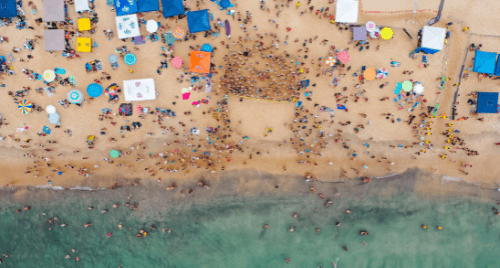
A significant regulatory shift is underway for the 2026 season. Coastal towns are cracking down on large shade structures, citing beach congestion, blocked emergency access lanes, and — most often — the fact that big tents block lifeguards' view of the water.
Before you spend a few hundred dollars on a trendy canopy, here's what to know about the 2026 bans, the practical flaws of flying shade fabrics on a real beach day, and what works in towns with an umbrellas-only rule.
What Beaches Are Banning Tents and Canopies in 2026?
A growing number of towns are enforcing "umbrellas only" mandates. Bring a banned structure and you may not just be asked to take it down — you could be fined.
1. Laguna Beach, California
- The rule: Laguna Beach has implemented an ordinance limiting shade coverings to standard beach umbrellas on nearly all city beaches. The city's stated reason is that multi-post tents and wide frames block lifeguards' view of the shoreline.
- The fine: Marine safety and beach patrol enforce the rule, and violators can face fines reported at up to $500.
- Source: SFGATE's reporting on the Laguna Beach canopy fine.
2. Myrtle Beach, South Carolina
- The rule: From Memorial Day through Labor Day, the only shade structures permitted on Myrtle Beach are traditional umbrellas. Tents, tarps, cabanas and pavilions are prohibited because they take up space and block access. Wind-powered fabric sails are generally treated as non-umbrella shade structures under these rules, so they fall under the same seasonal restriction — check with the city before assuming otherwise.
- Worth knowing: The sand near the water in Myrtle Beach is famously hard-packed. Our guide to the best wind-resistant umbrellas for Myrtle Beach covers what actually drives into dense sand.
3. Rehoboth Beach, Delaware
- The rule: Rehoboth Beach prohibits tents and canopies year-round. "Beach ambassadors" speak to violators first, and police can issue tickets if a structure isn't taken down.
- Source: Verify directly on Rehoboth's official beach rules page.
4. The New Jersey Shore, Outer Banks & Florida
- Major NJ Shore towns including Belmar and Seaside Heights have restricted large tents to preserve space on crowded beaches, and towns like Beach Haven and Manasquan enforce their own limits on large shade structures. Our guide to the best beach umbrellas for the New Jersey Shore covers the specifics.
- Outer Banks emergency-lane rules regulate large footprints near the dunes. See our best beach umbrellas for the Outer Banks guide.
- Florida varies sharply by municipality — and it's worth noting that a small number of towns regulate umbrellas too. Belleair Shore went furthest and banned beach umbrellas entirely. Ten minutes on your town's website before you travel is worth it.
The Practical Flaws: Tripping Hazards, Noise and Territory Wars
Beyond the local rules, the large parachute-style shades that have spread across beaches recently come with practical trade-offs that can shape your day.
As reported by the Wall Street Journal, these sprawling shades have generated complaints from locals and visitors alike.
The trade-offs of a "flying" shade:
- Lifeguard sightlines. This is the reason most often cited in the ordinances themselves. When many families set up large floating sails along the water's edge, it creates a near-continuous wall of fabric, and lifeguards lose their view of the waterline from the chair.
- Poles planted in the sand. A sail stays aloft on two poles driven into the sand and set well apart, with the corners weighted down by sandbags on calmer days. That's hardware spread out across a patch of beach rather than gathered at one point.
- Large footprints and territory conflicts. Beach patrols note that these canopies take up a lot of room on narrow stretches of beach, which leads to congestion and disputes over space.
- Noise. The fabric has to be light enough to fly, which means it flaps in a breeze. Beachgoers report that the constant snapping makes conversation harder.
- The still-air problem. A wind-powered shade needs wind. When the breeze drops, so does the canopy — and the shade with it.
What Works Where Shade Is Regulated
You don't need an expensive flapping parachute to get reliable shade, and you don't need to risk a ticket.
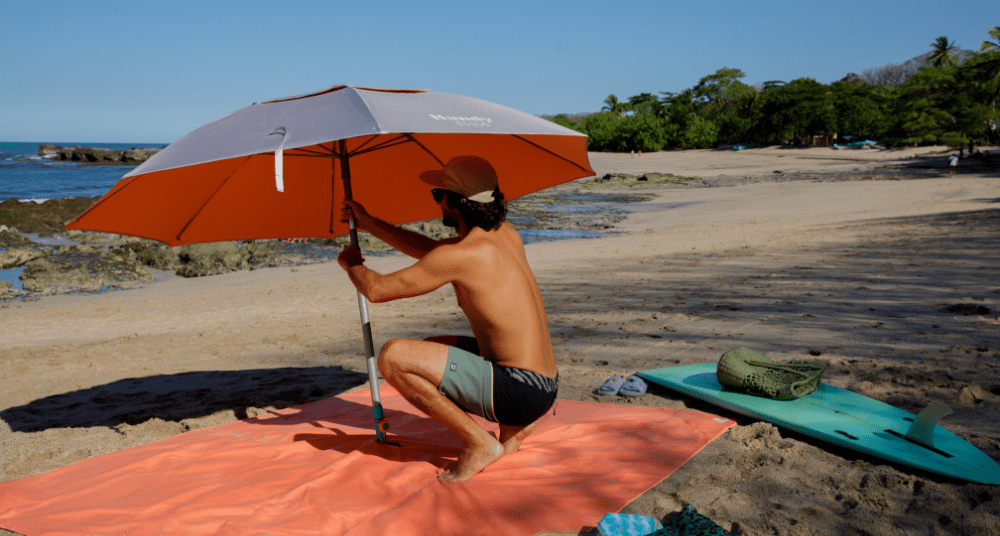
In towns with umbrellas-only rules, a traditional center-pole umbrella is the shade structure those rules are written to permit. A single vertical pole in the sand doesn't block sightlines and doesn't take up a footprint beyond the canopy above it. That's the whole reason these ordinances carve umbrellas out.
The one thing to check before you travel: a handful of towns cap umbrella height, and a very small number restrict umbrellas as well. Your beach's own website is the only reliable source.
But unlike a flimsy drugstore umbrella, the Handy Beach Umbrella & Anchor System is built for how people actually use shade:
- Dense fabric, because it doesn't have to fly. A shade that stays anchored doesn't need to be feather-light, so we don't compromise on fabric weight. Our 160gsm RPET canopy with a reflective silver layer on its top surface was independently lab tested at 0.008% UV transmission — 99.99% of UV blocked. The silver layer reflects both UV and infrared rather than absorbing it, so the air underneath stays cooler than it does under a dark canopy.
- Silent and stable. Whether the wind is up or the air is completely still, the shade stays structured. No flapping, no drooping, no waiting for a breeze.
- 10-second hammer-in anchor. An integrated slide hammer drives a heavy-duty steel stake two feet into the sand in about 10 seconds — past the dry loose surface layer into the damp packed sand that actually holds.
- Compliant with ASTM F3681. The safety standard for beach umbrellas and anchor devices, verified by independent wind tunnel testing at speeds up to 30 mph.
Don't let a banned canopy cut your beach day short.
👉 Shop the Handy Beach Umbrella & Anchor System
About the Author
Written by Agnes, co-founder of Handy Beach Goods and a Florida mom of two. After countless summer weekends on packed coasts, she knows a relaxing beach day comes down to gear that behaves. She engineered the Handy Beach Anchor as a faster, cleaner alternative for families who'd rather skip the sandbags and get to the water.
Beach regulations are set at the town or county level and change frequently, often between seasons. The details above reflect publicly available information as of September 2026 and are provided for general guidance only — always confirm current rules with your specific beach or municipality before you travel.