30-Second Summary: July 4th is the most crowded beach day of the American year. Canopy bans are in force in many towns, there's no room for a sprawling footprint, and prime sand is gone by mid-morning. Three things decide how your day goes: when you arrive, where you set up relative to the tide line, and whether your shade goes up in seconds or twenty minutes.
July 4th at the Beach: Surviving the Busiest Day of the Year
Independence Day is the single most congested beach day in the US calendar—and 2026 raised the bar, with the Semiquincentennial, the FIFA World Cup across US host cities and the "Sail 4th" fleet reviews all landing in the same fortnight.
Whatever the year, the pattern on the sand is the same. Turn up at 10:00 AM with a fifteen-foot canopy tent or a drug-store umbrella and you'll spend the day parked a long walk from your car, next to the bins, wrestling gear.
Here's how to navigate the crowds, stay on the right side of local rules, and claim your family's spot without losing the morning to it.
3 Rules for Surviving July 4th Crowds
When the beach is shoulder-to-shoulder, space and timing are the only currencies that matter. Here's how locals handle it:
1. The Golden Hours of Arrival
Arriving at 10:30 AM on the 4th means a mile walk from the car and whatever sand is left. There are two windows worth targeting:
- The early shift: before 8:00 AM. Premium parking, first pick of the sand, and the calmest winds of the day.
- The late shift: after 3:00 PM. Morning crowds start burning out and packing up, opening prime real estate just in time for the afternoon breeze and the fireworks.
2. Know the Local Canopy Rules
Many major beach towns restrict large tents, canopies and wind shades to reduce congestion and keep emergency lanes and lifeguard sightlines clear. Beach patrols enforce these hardest on holiday weekends, which is exactly when you'd least like to be repacking your gear. Even where wind shades are permitted, they need 10 to 15 feet of clearance for the poles and the fabric they hold up—on a packed holiday beach that's a lot of ground to claim across your neighbours' patch. (Our full breakdown of the 2026 beach canopy and tent ban rules covers which destinations are affected.)
3. Mind the High Tide Line
When space runs out, families start setting up closer and closer to the water. Find the damp sand line—the high tide mark—before you put anything down. Set up below it and you'll be moving camp in a hurry a few hours later, usually while holding a sandwich.
Know Your Coast: Local Beach Guides
Every coastline has its own sand density, wind pattern and local rules. Before you pack the car, check the guide for where you're headed:
- Florida: "Leave No Trace" sea turtle ordinances and soft, powdery sand.
- The New Jersey Shore: making the most of narrow, highly congested shorelines.
- Outer Banks, NC: anchoring safely in the sustained OBX winds.
- Myrtle Beach, SC: what it takes to get through Myrtle's hard-packed sand, plus the local tent rules.
- Gulf Shores, Alabama: sudden Gulf gusts and sugar-white sand.
- Cape Cod & Massachusetts: cold-water sea breezes and firm, coarse northern sand.
The 10-Second Base Camp
On a day like this you want a setup that goes up fast, takes only the space you've claimed, and doesn't need re-anchoring every hour.
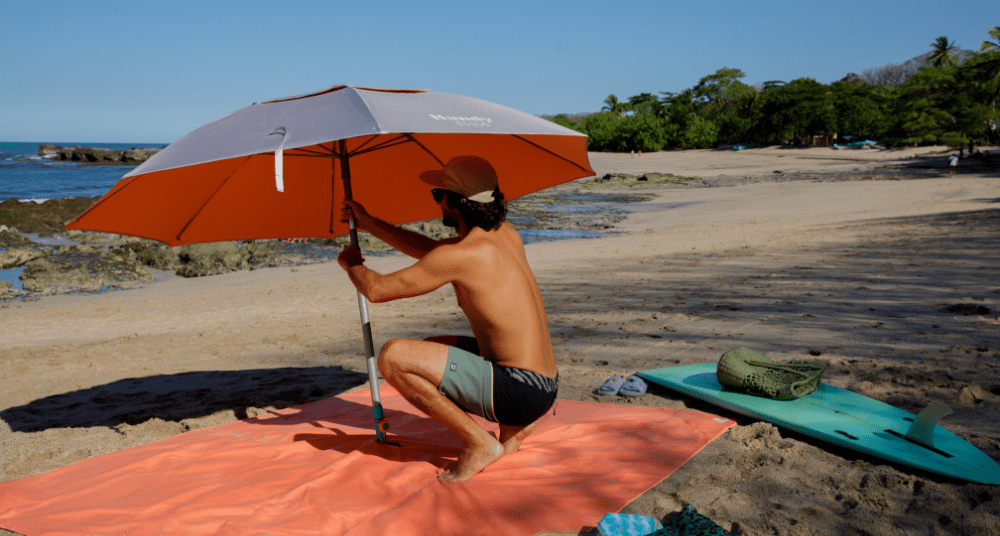
- A small footprint: the Handy Beach Umbrella uses a traditional centre-pole design, which is the configuration "umbrellas-only" ordinances are written to permit. You take up exactly the space you're sitting in. Rules vary by town and change between seasons, so check your beach's current regulations before you travel.
- Speed: a heavy-duty steel slide-hammer drives the anchor two feet into the sand in about 10 seconds. No twisting, no digging, no kneeling in front of an audience.
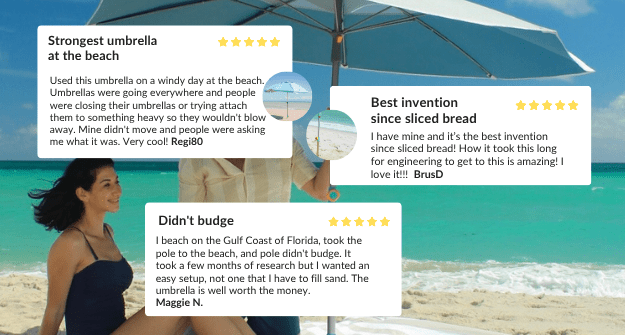
- Independently wind tunnel tested: the Handy Umbrella & Anchor System is compliant with ASTM F3681. In testing it was held at increasing speeds up to 30 mph, then at 30 mph for a further 30 minutes, without failing.
- The sand-free comfort zone: claim your territory with an oversized sand-free beach blanket. Unlike terrycloth towels, which act like sand magnets, it has a waterproof underside and a quick-dry microfiber top. No stakes to lose—you fill the four built-in corner pockets with sand to hold it down—and a discreet centre port lets your umbrella pole pass through the middle of the setup.
Choosing between shade options? Our guide to the best beach umbrella for wind compares the four anchor types, and the sand anchor guide explains what holds in soft sand and what doesn't.
Enjoy the fireworks, not the frustration. Get set up in the first ten minutes and the rest of the day is yours.
Still packing? Run through the beach packing checklist before you load the car.
👉 Shop the Handy Umbrella & Anchor System
About the Author
Written by Agnes, co-founder of Handy Beach Goods. As a coastal local, she knows exactly how chaotic a holiday beach day gets. She designed the Handy Umbrella & Anchor System for families who'd rather skip the heavy sandbags and get straight into the water.
Frequently Asked Questions: July 4th Beach Rules
Are beach tents and canopies banned on July 4th?
In many major coastal towns, yes—and the restriction usually runs all summer, not just the holiday. Cities including Laguna Beach, Myrtle Beach and Rehoboth Beach operate "umbrellas only" rules from Memorial Day to Labor Day. Councils give three reasons: large canopies block lifeguards' line of sight to the water, guy-lines obstruct emergency vehicle paths, and tents take up a disproportionate share of limited sand. Bringing a large canopy or wind shade can mean being asked to remove it, or a fine set by the local ordinance. A centre-pole umbrella is the setup those rules are written to allow—but check your destination's current regulations, because they differ by town and change between seasons.
What is the best beach shade for crowded beaches?
A compact, well-anchored centre-pole umbrella. It gives you real UV protection without an oversized footprint. Look at the canopy's measured UV transmission rather than a label number—ours was independently lab measured at 0.008%, meaning it blocks 99.99% of UV, and the silver top layer reflects infrared as well, so the air underneath stays cooler.
How do I keep my beach umbrella from blowing away in the wind?
The anchor does almost all the work. Skip cheap plastic twist-in augers and surface-sitting sandbags, and use a steel anchor that drives about two feet into denser sand below the surface layer. Look for gear that has been independently wind tunnel tested and is compliant with ASTM F3681.