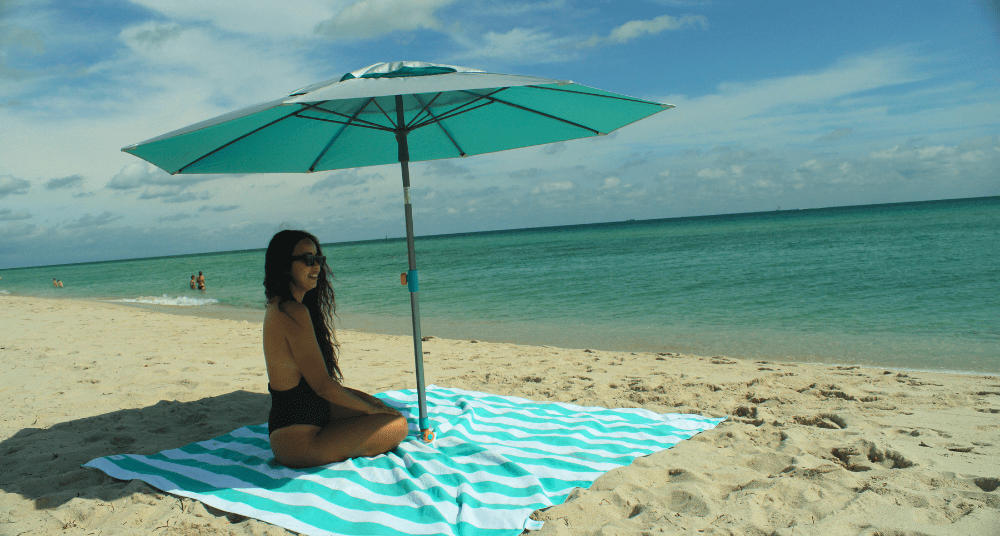
The 30-second version. Four questions separate beach umbrellas that work from ones that end up in a dune or send you home sunburnt. Ask a brand these and you will know more than any product page tells you:
- Wind: "Is it compliant with ASTM F3681, and how was that verified?"
- Sun: "What is the UV transmission percentage of the canopy?"
- Setup: "How long from bag to shade, and does anything need filling or digging?"
- Carrying: "How many pieces, and what does the whole thing weigh?"
Price and canopy diameter — the two things almost every comparison leads with — predict none of it.
Why the usual comparison doesn't work
Search for a beach umbrella and you get price, canopy size, colour, and the word "windproof." None of those three tell you whether it will still be standing at four o'clock, and the fourth is not a measurement of anything.
No beach umbrella is windproof. There is no test for it, no definition of it, and no brand that can be held to it. It is a marketing adjective that survived because nothing stopped it. What exists instead, since 2024, is an actual consumer safety standard — which is the first of the four axes.
The deeper problem is that the specs that matter are rarely in the same place, and sometimes aren't published at all. So the comparison below is organised around what to ask rather than what you will find pre-printed on a listing.
Axis 1 — Wind: what a number actually means
ASTM F3681 is the consumer safety specification for beach umbrellas and anchor devices, published by ASTM International. Before it, "wind-resistant" meant whatever the seller wanted it to mean.
Under the standard, a product must provide a resisting force of at least 75 pounds, or remain secure in wind speeds of up to 30 mph, when installed as instructed. The U.S. Consumer Product Safety Commission published a safety alert about it and tells shoppers to look for a label reading:
“MEETS ASTM F3681 FOR WIND SPEEDS UP TO 30 MPH”
Two things follow from that, and both are counterintuitive:
30 mph is the ceiling of the test, not the ceiling of a product. The standard holds an assembled umbrella and anchor at increasing speeds up to 30 mph, then at 30 mph for a further 30 minutes. There is no higher grade to earn, because the test does not go higher.
So a bigger wind number is not a better result — it is a different test. If you see 40, 44 or 50 mph advertised, that figure did not come from ASTM F3681, because F3681 does not measure there. It may come from a perfectly real test; it is simply not the one the CPSC points consumers at, and not one you can compare across brands. Note also whether the figure is a wind speed or a resistance force in pounds — those get used interchangeably in marketing and they are not the same measurement.
What to ask: "Is this compliant with ASTM F3681, and was it tested independently?" A good answer names the standard and says who tested it. A weak answer says "windproof," or quotes a number with no test attached.
ASTM F3681 is a voluntary consumer safety specification, not a federal regulation — worth knowing, because "federally approved" is not a thing in this category.
Full detail in our beach umbrella wind safety guide.
Axis 2 — Sun: ask for transmission, not a UPF rating
This is the axis most shoppers skip, and the one with the widest real spread between products.
Sun-protective fabric is labelled on the UPF scale. Under ASTM D6603, the labelling standard for sun-protective textiles, 50+ is the highest rating any fabric may carry — regardless of how far past it the fabric actually performs.
Which means the label cannot answer the question you are asking. A canopy that blocks 98% of UV and one that blocks 99.99% can wear exactly the same "UPF 50+" tag. One of those lets through 250 times more ultraviolet light than the other.
The figure that is not capped is UV transmission percentage — how much UV passes through the material. A standard UPF 50 fabric transmits about 2%. Our 7ft canopy was independently lab measured at 0.008%, which is 99.99% blocked.
What to ask: "What is the UV transmission percentage?" Nobody is obliged to publish it, and plenty of brands do not have it — which is itself information. If the only answer available is "UPF 50+," you are being told the band and not the position in it.
Two related things worth checking while you are asking:
- Is there a vent? An open canopy generates lift like a wing. A vent lets pressure spill through the top instead of building underneath. It matters for wind, not just for heat.
- Is the reflective layer on the top surface or underneath? On the outside it bounces UV and heat away before the fabric absorbs them. Underneath, the fabric has already absorbed the heat and is radiating it down at you.
And one honest limit on this axis: no canopy stops reflected UV. Dry sand bounces roughly 15% back up at you. A better canopy closes the overhead path completely and leaves the reflected path untouched, which is why sunscreen is not optional under even the densest shade. We went into that in can you get sunburned under a beach umbrella?
Axis 3 — Setup: the axis nobody measures
There is no standard for this and nobody advertises it in comparable units, which is exactly why it is worth asking about. It is also the axis that decides whether the gear gets used at all.
Three mechanisms dominate the category, and they differ by what you have to do rather than by how well they hold:
- Hold by depth — a shaft driven into the sand until it reaches the damp packed layer. Nothing to fill, nothing to dig. Effort is one short burst at the start.
- Hold by mass — a base filled with sand on site. You dig a seat for it, fill it, level it, and empty it again before you leave. It works, and it is a genuine multi-step job at both ends of the day.
- Hold by friction — a screw-in auger twisted into the surface. Quick in packed sand, prone to spinning in dry sugar sand, and typically only six to eight inches deep.
What to ask: "How long from bag to shade, and does anything need to be filled or dug?" The second half of that question is the one that matters. A product that needs sand loaded into it has a step that cannot be shortened, and a tool to carry for doing it.
Our own figure, for reference: the anchor drives two feet down in about 10 seconds using a slide hammer built into the lower pole, and comes out in about five. The honest version of why that matters is not that ten seconds is thrilling — it is that gear requiring setup effort stays in the garage. The best umbrella in the world protects nobody on the days you decide not to bring it.
Axis 4 — What you actually carry
Weight gets quoted. Piece count almost never does, and it is the one you feel walking from the car.
Ask for three numbers: all-in weight, number of pieces, and whether a separate tool is needed. A system can be light on paper and still mean four trips — canopy, base, digging tool, bag.
Also worth asking: are parts replaceable? A beach umbrella lives in salt air and abrasive sand. If one collar failing means a new umbrella, the lifetime cost is not the sticker price.
The comparison, by mechanism
Brand names are not useful here, because within each mechanism the products behave broadly alike. Compare the mechanism first, then the specific product.
| Handy hammer-in anchor | Sand-filled base | Screw-in auger | Wind-powered sail | Budget umbrella + sandbag | |
|---|---|---|---|---|---|
| How it holds | Depth — grips along the buried shaft | Mass — weight of loaded sand | Friction in the surface layer | Aerodynamics — needs wind to stay up | Mass, loosely |
| Typical depth reached | Up to 2 ft | Surface — sits on top | 6–8 in | Guy lines and sand bags | 6–12 in |
| Setup steps | Drive it, lock, open canopy | Dig a seat, fill, level, assemble | Twist in, assemble | Stake out, let it fill | Push in, fill bags, hope |
| Takedown | Unlock, pull straight up | Empty the base, then pack | Twist out | Collapse, pack lines | Empty bags |
| Needs filling or digging | No | Yes | Yes | Usually yes | Yes |
| Separate tool to carry | No — hammer is built into the pole | A scoop or digger | No | Stakes | Bags |
| Works in dry sugar sand | Yes | Yes | Poorly — can spin | Yes | Poorly |
| Works with no wind | Yes | Yes | Yes | No — needs breeze | Yes |
| ASTM F3681 compliance common? | Yes | Some products | Rare | Not applicable — different product class | No |
| Best for | Real coastal wind, frequent use, set-and-forget | All-day camps where setup time is no object | Packed sand, light breeze, low budget | Shading a group on reliably breezy beaches | Occasional calm days |
| Worst for | Anyone wanting the lightest possible bag | Short visits, carrying far, loose powder at the top of the beach | Dry sugar sand and gusts | Still, hot days with no wind | Any real wind |
Pros and cons, stated plainly
Deep hammer-in anchor
Pros: reaches the sand that actually holds; fastest setup of the three anchoring types; nothing to fill or dig; no separate tool; works in loose dry sand where augers slip.
Cons: the anchor is steel, so it is heavier than a plastic add-on; you must drive it to full depth or you lose the whole advantage; pole diameter compatibility needs checking if you are pairing it with a canopy you already own.
Sand-filled base
Pros: genuinely effective — loaded mass is a sound way to hold an umbrella; the base folds small and weighs little empty; some products are independently tested to the standard.
Cons: a multi-step job at both ends of every trip; usually a digging tool to carry; bulky and wet to pack once used; the hold depends entirely on the user filling it properly, so a hurried setup is a weaker setup.
Screw-in auger
Pros: cheapest route to some stability; light; packs flat.
Cons: shallow by design; spins in dry sugar sand; plastic versions crack; slowest-feeling setup because twisting resistance rises as you go.
Wind-powered sail
Pros: very large shaded area for very little carried weight; uses the wind instead of fighting it.
Cons: needs wind to work, so a still hot day is its weakest case; the shade moves as the breeze shifts; lightweight fabrics tend toward higher UV transmission; a large footprint is restricted on some crowded or regulated beaches.
Budget umbrella with sandbags
Pros: cheap; fine for calm days and grassy parks.
Cons: the thing most likely to invert, snap a rib, or leave the sand entirely. Replacement cost over three seasons usually exceeds buying once properly.
Where we come out — and where we don't
We make a deep hammer-in system, so take this section accordingly. Here is the honest shape of it.
If the single highest advertised wind figure is your only criterion, a sand-filled base will usually quote a bigger number. It holds by mass, and you can always load more mass. That is a real engineering advantage and we are not going to pretend otherwise.
What that number costs you is the rest of the table: digging a seat, filling the base, levelling it, emptying it before you leave, a tool to carry for doing it, and a wet bulky base to pack. If you set up once and stay all day, that trade is probably worth it. If you go twice a week with children, it is the reason the umbrella stops coming.
And on the measurement that the CPSC actually tells shoppers to look for — compliance with ASTM F3681 at wind speeds up to 30 mph — a compliant hammer-in anchor and a compliant filled base are holding the same certificate.
Our four numbers, so you can put them in the table yourself:
| Wind | Independently wind tunnel tested and compliant with ASTM F3681 — held at increasing speeds up to 30 mph, then at 30 mph for a further 30 minutes |
| UV transmission | 0.008% — 99.99% of UV blocked, independently lab measured. 7 ft, vented, 160gsm recycled rPET, 8mm fiberglass ribs |
| Setup / takedown | About 10 seconds / about 5 seconds. Nothing to fill, nothing to dig, no separate tool |
| What you carry | 9.2 lbs all in — a 4.8 lb steel anchor and a 7 ft canopy, two pieces in one shoulder bag. Parts replaceable. 5-year anchor / 2-year canopy warranty |
That is the Handy Beach Umbrella & Sand Anchor System at $149.99 with the anchor included. The anchor on its own is $75 and replaces the base pole on a canopy you already have.
Frequently asked questions
How do you compare beach umbrellas properly?
On four axes, not two. Wind — compliance with ASTM F3681 and who verified it. Sun — the UV transmission percentage, because the UPF scale is capped at 50+. Setup — time from bag to shade, and whether anything must be filled or dug. Carrying — all-in weight and number of pieces. Price and canopy diameter predict none of these.
What does ASTM F3681 actually require?
A resisting force of at least 75 pounds, or remaining secure in wind speeds of up to 30 mph, when installed as instructed. The CPSC tells shoppers to look for a label reading “MEETS ASTM F3681 FOR WIND SPEEDS UP TO 30 MPH.” It is a voluntary consumer safety specification, not a federal regulation.
Is a 44 mph umbrella better than a 30 mph umbrella?
Not in any way you can verify by comparing those two numbers. 30 mph is where the ASTM F3681 test ends, so any higher figure came from a different test with different conditions. You are comparing two measurements of different things. Check which standard a figure refers to before weighing it.
Why shouldn't I just compare UPF ratings?
Because under ASTM D6603 the consumer UPF scale stops at 50+, so a fabric blocking 98% and one blocking 99.99% carry the identical label while one passes 250 times more UV. Ask for the UV transmission percentage instead — that figure is not capped.
Does a bigger canopy mean better shade?
More area, yes. Better protection, not necessarily — a large thin canopy can transmit more UV than a smaller dense one. And a bigger canopy catches more wind, so it raises the demand on the anchor. Size and fabric density are separate questions.
How much should a good beach umbrella cost?
The useful way to think about it is replacement cycles rather than sticker price. A $40 umbrella that inverts in its first windy summer costs $120 across three seasons and leaves three umbrellas in a bin. Ask whether parts are replaceable and what the warranty covers — those two answers tell you more about cost than the price does.
What is the most important single factor?
Anchor depth, if you are forced to pick one. Most beach umbrellas reach six to twelve inches, which is the dry loose surface layer — and that layer gets looser through the day as the sun dries it out. The hold comes from the damp packed sand beneath it.
The honest verdict
You cannot compare beach umbrellas from the information most listings give you, so the practical skill is knowing which four questions to ask and recognising a weak answer. A brand that names the standard, publishes a transmission figure, tells you the setup time and the piece count is a brand that measured its product. One that says "windproof" and "UPF 50+" has told you nothing you can check.
Ask the four. Then buy whichever mechanism matches how you actually use a beach — not the biggest number on the box.
About the Author
Written by Agnes, co-founder of Handy Beach Goods and a Florida mom. We design our gear in Florida and test it on the beaches we actually use — which is how a four-question checklist ended up mattering more to us than a spec sheet.